
Ch. 3 - Derivatives
Briggs - Calculus: Early Transcendentals 3rd Edition
Briggs3rd EditionCalculus: Early TranscendentalsISBN: 9780136847243Not the one you use?Change textbook
Chapter 3, Problem 26b

Suppose a baseball is thrown vertically upward from the ground with an initial velocity of v0 ft/s. The approximate height of the ball (in feet) above the ground after t seconds is given by s(t) = -16t² + v0t.
With what velocity does the ball strike the ground?

Verified step by step guidance
1
Step 1: Understand the problem. We need to find the velocity of the baseball when it strikes the ground. The height function is given by s(t) = -16t^2 + v_0t, where s(t) is the height at time t, and v_0 is the initial velocity.
Step 2: Determine when the ball hits the ground. The ball strikes the ground when its height s(t) is 0. Set the equation -16t^2 + v_0t = 0 and solve for t.
Step 3: Factor the equation -16t^2 + v_0t = 0 to find the time t when the ball hits the ground. This can be factored as t(-16t + v_0) = 0, giving solutions for t.
Step 4: Use the derivative to find the velocity. The velocity function v(t) is the derivative of the height function s(t). Differentiate s(t) = -16t^2 + v_0t to find v(t).
Step 5: Substitute the time when the ball hits the ground into the velocity function v(t) to find the velocity at that moment. This will give the velocity with which the ball strikes the ground.

Verified video answer for a similar problem:

This video solution was recommended by our tutors as helpful for the problem above.
Video duration:
5m
Was this helpful?

Key Concepts

Here are the essential concepts you must grasp in order to answer the question correctly.

Quadratic Functions

The height of the baseball is modeled by a quadratic function, s(t) = -16t² + v₀t, where the term -16t² represents the effect of gravity, and v₀t represents the initial upward velocity. Understanding the properties of quadratic functions, such as their parabolic shape and vertex, is essential for analyzing the motion of the baseball.
Recommended video:
6:04
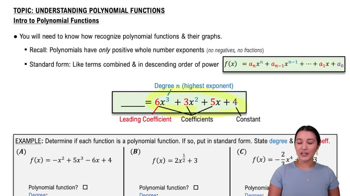
Introduction to Polynomial Functions

Velocity and Acceleration

Velocity is the rate of change of position with respect to time, while acceleration is the rate of change of velocity. In this scenario, the ball's velocity can be determined by taking the derivative of the height function s(t), which gives the velocity function v(t) = s'(t) = -32t + v₀. This relationship is crucial for finding the velocity at which the ball strikes the ground.
Recommended video:
06:15
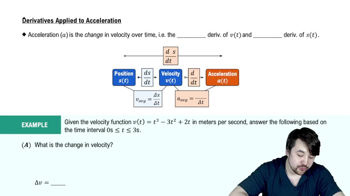
Derivatives Applied To Acceleration

Finding Roots of Functions

To determine when the baseball strikes the ground, we need to find the time t when the height s(t) equals zero. This involves solving the equation -16t² + v₀t = 0, which can be factored to find the roots. Understanding how to solve quadratic equations is vital for determining the time of impact and subsequently calculating the velocity at that moment.
Recommended video:
05:21
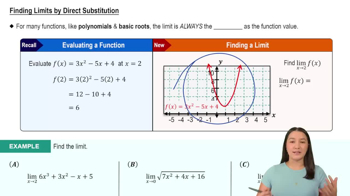
Finding Limits by Direct Substitution