Ch. 3 - Derivatives
Briggs - Calculus: Early Transcendentals 3rd Edition
Briggs3rd EditionCalculus: Early TranscendentalsISBN: 9780136847243Not the one you use?Change textbook
Chapter 3, Problem 3.14

9–61. Evaluate and simplify y'.


y = (2x−3)x^3/2

Verified step by step guidance
1
Step 1: Identify the function y = (2x - 3)x^{3/2}. This is a product of two functions, so we will use the product rule to differentiate it.
Step 2: Recall the product rule for differentiation: if y = u(x)v(x), then y' = u'(x)v(x) + u(x)v'(x). Here, let u(x) = 2x - 3 and v(x) = x^{3/2}.
Step 3: Differentiate u(x) = 2x - 3. The derivative u'(x) is 2, since the derivative of 2x is 2 and the derivative of a constant is 0.
Step 4: Differentiate v(x) = x^{3/2}. Use the power rule for differentiation: if v(x) = x^n, then v'(x) = nx^{n-1}. Here, n = 3/2, so v'(x) = (3/2)x^{1/2}.
Step 5: Apply the product rule: y' = u'(x)v(x) + u(x)v'(x). Substitute u'(x), v(x), u(x), and v'(x) into this formula to find y'.

Verified video answer for a similar problem:

This video solution was recommended by our tutors as helpful for the problem above.
Video duration:
4m
Was this helpful?

Key Concepts

Here are the essential concepts you must grasp in order to answer the question correctly.

Differentiation

Differentiation is a fundamental concept in calculus that involves finding the derivative of a function. The derivative represents the rate of change of the function with respect to its variable. In this case, we need to apply differentiation rules to the given function y = (2x−3)x^(3/2) to find y'.
Recommended video:
05:53
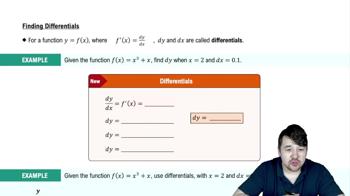
Finding Differentials

Product Rule

The Product Rule is a specific rule used in differentiation when dealing with the product of two functions. It states that if you have two functions u(x) and v(x), the derivative of their product is given by u'v + uv'. In the context of the given function, we will apply the Product Rule to differentiate the two components: (2x−3) and x^(3/2).
Recommended video:
05:18
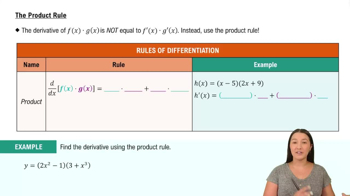
The Product Rule

Simplification

Simplification in calculus involves reducing an expression to its simplest form after differentiation. This may include combining like terms, factoring, or reducing fractions. After finding the derivative y', it is essential to simplify the expression to make it easier to interpret and use in further calculations.
Recommended video:
03:00
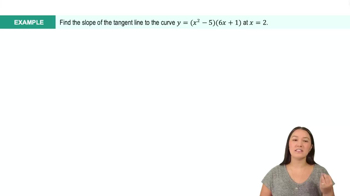
The Product Rule Example 2
Related Practice
Textbook Question

Verifying derivative formulas Verify the following derivative formulas using the Quotient Rule.

d/dx (csc x) = -csc x cot x

276
views

Textbook Question

27–40. Implicit differentiation Use implicit differentiation to find dy/dx.

√x⁴+y² = 5x+2y³

304
views
Textbook Question

Orthogonal trajectories Two curves are orthogonal to each other if their tangent lines are perpendicular at each point of intersection (recall that two lines are perpendicular to each other if their slopes are negative reciprocals). A family of curves forms orthogonal trajectories with another family of curves if each curve in one family is orthogonal to each curve in the other family. For example, the parabolas y = cx² form orthogonal trajectories with the family of ellipses x²+2y² = k, where c and k are constants (see figure).

Find dy/dx for each equation of the following pairs. Use the derivatives to explain why the families of curves form orthogonal trajectories. <IMAGE>


y = cx²; x²+2y² = k, where c and k are constants

473
views
Textbook Question

Vertical tangent lines If a function f is continuous at a and lim x→a| f′(x)|=∞, then the curve y=f(x) has a vertical tangent line at a, and the equation of the tangent line is x=a. If a is an endpoint of a domain, then the appropriate one-sided derivative (Exercises 71–72) is used. Use this information to answer the following questions.

Graph the following curves and determine the location of any vertical tangent lines.

a. x²+y² = 9

247
views
Textbook Question

If f is a one-to-one function with f(3)=8 and f′(3)=7, find the equation of the line tangent to y=f^−1(x) at x=8.

192
views
Textbook Question

27–76. Calculate the derivative of the following functions.

y=(x2+2x+7)8y=\(\left\)(x^2+2x+7\(\right\))^8

326
views