Ch. 2 - Limits
Briggs - Calculus: Early Transcendentals 3rd Edition
Briggs3rd EditionCalculus: Early TranscendentalsISBN: 9780136847243Not the one you use?Change textbook
Chapter 2, Problem 2.10

Determine the following limits at infinity.


lim x→∞ (5 + 1/x +10/x^2)

Verified step by step guidance
1
Identify the terms in the expression: \(5 + \frac{1}{x} + \frac{10}{x^2}\).
Recognize that as \(x\) approaches infinity, \(\frac{1}{x}\) and \(\frac{10}{x^2}\) both approach 0.
Understand that the term \(5\) is a constant and does not change as \(x\) approaches infinity.
Apply the limit to each term separately: \(\lim_{{x \to \infty}} 5 = 5\), \(\lim_{{x \to \infty}} \frac{1}{x} = 0\), and \(\lim_{{x \to \infty}} \frac{10}{x^2} = 0\).
Combine the results of the limits: \(5 + 0 + 0\).

Verified video answer for a similar problem:

This video solution was recommended by our tutors as helpful for the problem above.
Video duration:
5m
Was this helpful?

Key Concepts

Here are the essential concepts you must grasp in order to answer the question correctly.

Limits at Infinity

Limits at infinity refer to the behavior of a function as the input approaches infinity. This concept is crucial in calculus for understanding how functions behave for very large values of x, which can help determine horizontal asymptotes and the end behavior of functions.
Recommended video:
05:50
One-Sided Limits

Dominant Terms

In the context of limits, dominant terms are the parts of a function that have the most significant impact on its value as x approaches infinity. For rational functions, the highest degree terms in the numerator and denominator typically dominate, allowing for simplification when evaluating limits.
Recommended video:
2:02
Simplifying Trig Expressions Example 1

Continuous Functions

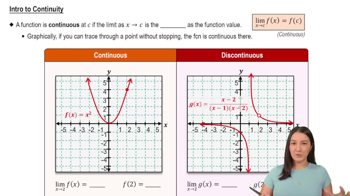
A continuous function is one where small changes in the input result in small changes in the output. This property is essential when evaluating limits, as it allows us to substitute values directly into the function, provided the function is defined at that point, especially as x approaches infinity.
Recommended video:
05:34
Intro to Continuity