Ch. 4 - Applications of the Derivative
Briggs - Calculus: Early Transcendentals 3rd Edition
Briggs3rd EditionCalculus: Early TranscendentalsISBN: 9780136847243Not the one you use?Change textbook
Chapter 4, Problem 4.2.1

Explain Rolle’s Theorem with a sketch.

Verified step by step guidance
1
Rolle's Theorem is a fundamental result in calculus that applies to continuous functions. It states that if a function f is continuous on a closed interval [a, b], differentiable on the open interval (a, b), and f(a) = f(b), then there exists at least one c in (a, b) such that the derivative f'(c) = 0.
To visualize Rolle's Theorem, imagine a smooth curve representing the function f(x) on the interval [a, b]. Since f(a) = f(b), the curve starts and ends at the same height, creating a horizontal line at these endpoints.
The requirement that the function is continuous and differentiable ensures that there are no breaks, jumps, or sharp corners in the curve. This smoothness implies that somewhere between a and b, the curve must have a horizontal tangent line, indicating a point where the slope is zero.
Sketch the graph of a function that satisfies the conditions of Rolle's Theorem. Start by drawing the x-axis and marking the points a and b. Plot the function such that f(a) = f(b), ensuring the curve is smooth and continuous between these points.
Identify the point c in the interval (a, b) where the tangent to the curve is horizontal. This point c is where the derivative f'(c) = 0, demonstrating the conclusion of Rolle's Theorem.

Verified video answer for a similar problem:

This video solution was recommended by our tutors as helpful for the problem above.
Video duration:
6m
Was this helpful?

Key Concepts

Here are the essential concepts you must grasp in order to answer the question correctly.

Rolle's Theorem

Rolle's Theorem states that if a function is continuous on a closed interval [a, b], differentiable on the open interval (a, b), and the function values at the endpoints are equal (f(a) = f(b)), then there exists at least one point c in (a, b) where the derivative f'(c) = 0. This theorem is fundamental in understanding the behavior of functions and their critical points.
Recommended video:
06:11
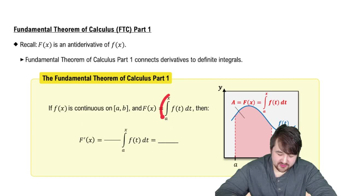
Fundamental Theorem of Calculus Part 1

Continuity and Differentiability

Continuity of a function at a point means that the function does not have any breaks, jumps, or holes at that point, while differentiability means that the function has a defined derivative at that point. For Rolle's Theorem to apply, the function must be both continuous on the closed interval and differentiable on the open interval, ensuring smooth behavior without abrupt changes.
Recommended video:
05:34
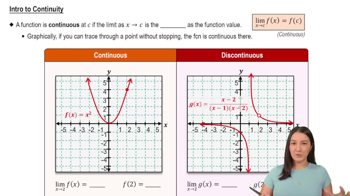
Intro to Continuity

Critical Points

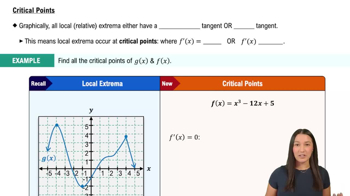
Critical points of a function occur where its derivative is zero or undefined. In the context of Rolle's Theorem, the existence of at least one critical point c, where f'(c) = 0, indicates that the function has a horizontal tangent line at that point. This is significant for analyzing the function's local maxima and minima within the interval.
Recommended video:
04:50
Critical Points