Ch. 1 - Functions
Hass - Thomas' Calculus 15th Edition
Hass15th EditionThomas' CalculusISBN: 9780137616077Not the one you use?Change textbook
Chapter 1, Problem 33d

State whether each function is increasing, decreasing, or neither.


d. Kinetic energy as a function of a particle’s velocity

Verified step by step guidance
1
Understand the relationship between kinetic energy and velocity. The kinetic energy (KE) of a particle is given by the formula: KE = 12mv2, where m is the mass of the particle and v is its velocity.
Identify the variable of interest. In this case, we are considering kinetic energy as a function of velocity, so v is the variable.
Differentiate the kinetic energy function with respect to velocity to determine the rate of change. The derivative of 12mv2 with respect to v is mv.
Analyze the sign of the derivative. Since mass m is positive and velocity v is also positive for increasing velocity, the derivative mv is positive.
Conclude based on the derivative. Since the derivative is positive, the kinetic energy function is increasing as a function of velocity.

Verified video answer for a similar problem:

This video solution was recommended by our tutors as helpful for the problem above.
Video duration:
2m
Was this helpful?

Key Concepts

Here are the essential concepts you must grasp in order to answer the question correctly.

Kinetic Energy Formula

Kinetic energy (KE) is defined by the formula KE = 1/2 mv², where m is the mass of the particle and v is its velocity. This formula indicates that kinetic energy is directly proportional to the square of the velocity, meaning as velocity increases, kinetic energy increases as well.
Recommended video:
06:51
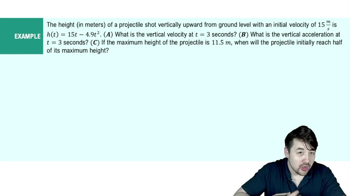
Derivatives Applied To Acceleration Example 2

Increasing and Decreasing Functions

A function is considered increasing if, for any two points x1 and x2 where x1 < x2, the function value at x1 is less than the function value at x2 (f(x1) < f(x2)). Conversely, a function is decreasing if f(x1) > f(x2) under the same conditions. Understanding these definitions is crucial for analyzing the behavior of functions.
Recommended video:
07:32
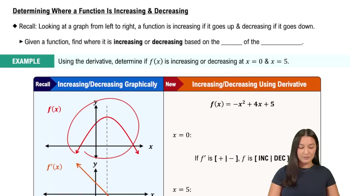
Determining Where a Function is Increasing & Decreasing

Derivative and Monotonicity

The derivative of a function provides information about its rate of change. If the derivative of a function is positive over an interval, the function is increasing; if negative, it is decreasing. For kinetic energy as a function of velocity, the derivative with respect to velocity will indicate whether the kinetic energy is increasing or decreasing as velocity changes.
Recommended video:
05:44
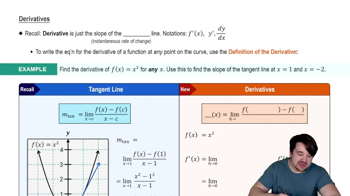
Derivatives