Find the limits in Exercises 49–52. Write ∞ or −∞ where appropriate.
lim x→(−π/2)⁺ sec x
Verified step by step guidance
1
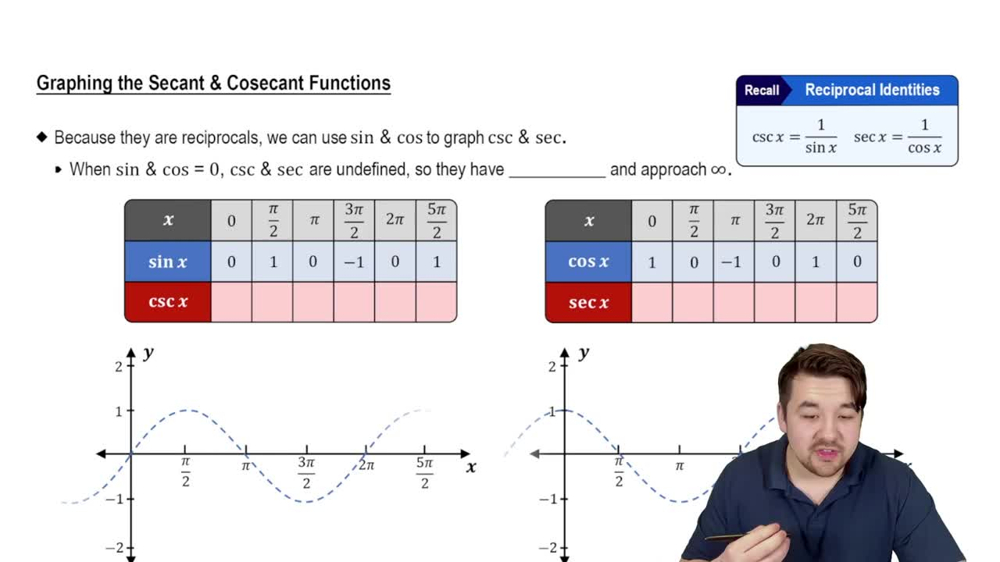
Understand the function: The secant function, sec(x), is defined as 1/cos(x). As x approaches a certain value, we need to consider the behavior of the cosine function.
Identify the point of interest: We are looking at the limit as x approaches -π/2 from the right (denoted as x→(-π/2)⁺). This means we are considering values of x that are slightly greater than -π/2.
Analyze the cosine function: At x = -π/2, cos(x) is 0. As x approaches -π/2 from the right, cos(x) approaches 0 from the positive side, meaning cos(x) is positive but very small.
Consider the behavior of sec(x): Since sec(x) = 1/cos(x), as cos(x) approaches 0 from the positive side, sec(x) will become very large. This indicates that sec(x) approaches positive infinity.
Conclude the limit: Based on the analysis, the limit of sec(x) as x approaches -π/2 from the right is ∞.
Verified video answer for a similar problem:
This video solution was recommended by our tutors as helpful for the problem above
Video duration:
2m
Play a video:
0 Comments
Key Concepts
Here are the essential concepts you must grasp in order to answer the question correctly.
Limits
Limits are fundamental concepts in calculus that describe the behavior of a function as its input approaches a certain value. They help in understanding how functions behave near points of interest, including points of discontinuity or infinity. Evaluating limits is essential for defining derivatives and integrals, which are core components of calculus.
The secant function, denoted as sec(x), is defined as the reciprocal of the cosine function: sec(x) = 1/cos(x). It is important to understand the behavior of sec(x) as x approaches certain values, particularly where cos(x) equals zero, since this leads to undefined values and vertical asymptotes in the secant function.
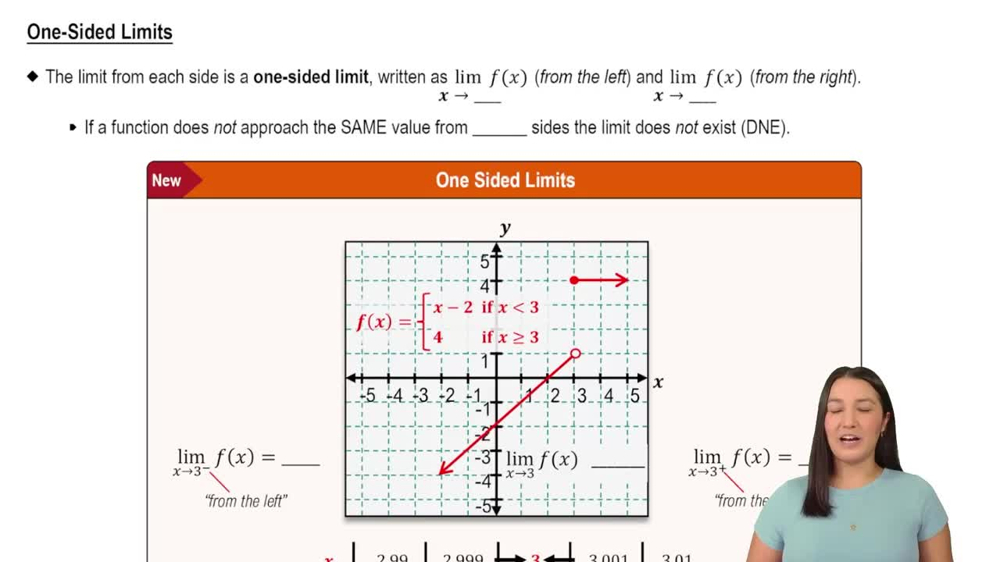
One-sided limits refer to the value that a function approaches as the input approaches a specific point from one side, either the left (−) or the right (+). In the context of the given limit, evaluating the right-hand limit as x approaches −π/2 helps determine the behavior of sec(x) near this critical point, which is essential for understanding discontinuities in the function.