
Ch. 3 - Derivatives
Briggs - Calculus: Early Transcendentals 3rd Edition
Briggs3rd EditionCalculus: Early TranscendentalsISBN: 9780136847243Not the one you use?Change textbook
Chapter 3, Problem 3.5.55b

An object oscillates along a vertical line, and its position in centimeters is given by y(t) = 30(sint - 1), where t ≥ 0 is measured in seconds and y is positive in the upward direction.
Find the velocity of the oscillator, v(t) =y′(t).

Verified step by step guidance
1
To find the velocity of the oscillator, we need to differentiate the position function y(t) = 30(sin(t) - 1) with respect to time t.
Recall that the derivative of sin(t) with respect to t is cos(t). Therefore, apply the derivative to each term in the function y(t).
The derivative of the constant term -30 is 0, since constants do not change with respect to t.
Differentiate the term 30sin(t) using the chain rule. The derivative of 30sin(t) is 30cos(t).
Combine the derivatives to get the velocity function v(t) = y'(t) = 30cos(t).

Verified video answer for a similar problem:

This video solution was recommended by our tutors as helpful for the problem above.
Video duration:
2m
Was this helpful?

Key Concepts

Here are the essential concepts you must grasp in order to answer the question correctly.

Differentiation

Differentiation is a fundamental concept in calculus that involves finding the derivative of a function. The derivative represents the rate of change of the function with respect to its variable. In this context, differentiating the position function y(t) = 30(sin(t) - 1) will yield the velocity function v(t), which describes how the position of the object changes over time.
Recommended video:
05:53
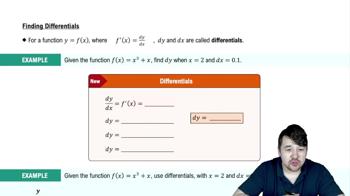
Finding Differentials

Trigonometric Functions

Trigonometric functions, such as sine and cosine, are essential in modeling periodic phenomena, including oscillations. The sine function, in particular, describes the oscillatory behavior of the object in this problem. Understanding the properties of these functions, including their ranges and periodicity, is crucial for analyzing the motion of the oscillator.
Recommended video:
6:04
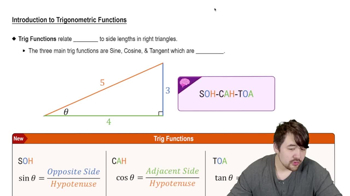
Introduction to Trigonometric Functions

Velocity

Velocity is a vector quantity that indicates the rate of change of an object's position with respect to time. In this scenario, the velocity function v(t) is derived from the position function y(t) by differentiation. It provides insight into how fast and in which direction the object is moving along the vertical line, which is vital for understanding its oscillatory motion.
Recommended video:
06:29
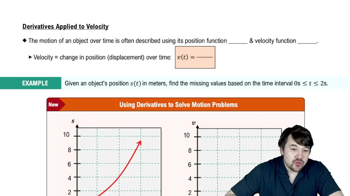
Derivatives Applied To Velocity