

The height above the ground of a stone thrown upwards is given by s(t), where t is measured in seconds. After 1 second, the height of the stone is 48 feet above the ground, and after 1.5 seconds, the height of the stone is 60 feet above the ground. Evaluate s(1) and s(1.5), and then find the average velocity of the stone over the time interval [1, 1.5].
Ch. 2 - Limits
Briggs3rd EditionCalculus: Early TranscendentalsISBN: 9780136847243Not the one you use?Change textbook
Chapter 2, Problem 2.R.49
Determine the following limits.
lim x→∞ (5 + (cos4 x) / (x2 + x + 1))
Verified step by step guidance1
Identify the dominant term in the expression as \(x\) approaches infinity. The term \(5\) is constant, and the fraction \(\frac{\cos^4 x}{x^2 + x + 1}\) will determine the behavior of the limit.
Recognize that \(\cos^4 x\) is bounded between 0 and 1, since \(\cos x\) is bounded between -1 and 1.
Consider the denominator \(x^2 + x + 1\), which grows without bound as \(x\) approaches infinity.
Since the numerator \(\cos^4 x\) is bounded and the denominator \(x^2 + x + 1\) grows indefinitely, the fraction \(\frac{\cos^4 x}{x^2 + x + 1}\) approaches 0 as \(x\) approaches infinity.
Conclude that the limit is determined by the constant term, so \(\lim_{x \to \infty} \left(5 + \frac{\cos^4 x}{x^2 + x + 1}\right) = 5\).

Verified video answer for a similar problem:
This video solution was recommended by our tutors as helpful for the problem above.
Video duration:
4mWas this helpful?
Key Concepts
Here are the essential concepts you must grasp in order to answer the question correctly.
Limits at Infinity
Limits at infinity involve evaluating the behavior of a function as the input approaches infinity. In this context, we analyze how the function behaves when x becomes very large, which often simplifies the expression by focusing on the dominant terms.
Recommended video:
One-Sided Limits
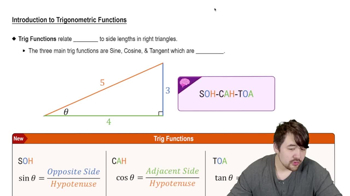
Behavior of Trigonometric Functions
Trigonometric functions, such as cosine, oscillate between fixed values. In this limit problem, cos<sup>4</sup>(x) will always yield values between 0 and 1, which is crucial for determining the limit as x approaches infinity.
Recommended video:
Introduction to Trigonometric Functions
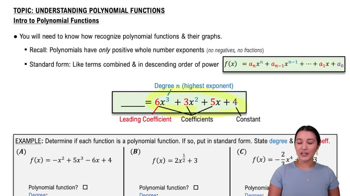
Polynomial Growth
In calculus, polynomial growth refers to how polynomial functions behave as their variable approaches infinity. In this limit, the denominator x<sup>2</sup> + x + 1 grows significantly larger than the numerator, influencing the overall limit of the expression.
Recommended video:
Introduction to Polynomial Functions
Related Practice
Textbook Question
251
views
Textbook Question
Determine the following limits.
354
views
Textbook Question
Use the graph of in the figure to determine the values of in the interval at which f fails to be continuous. Justify your answers using the continuity checklist.
<IMAGE>
314
views
Textbook Question
Let .
Determine values of the constants and , if possible, for which is continuous at .
361
views
Textbook Question
Determine the interval(s) on which the following functions are continuous.
p(x)=3x^2−6x+7 / x^2+x+1
286
views
Textbook Question
Determine the following limits.
lim x→∞ (3x12 − 9x7)
408
views
