Ch. 1 - Functions
Hass - Thomas' Calculus 15th Edition
Hass15th EditionThomas' CalculusISBN: 9780137616077Not the one you use?Change textbook
Chapter 1, Problem 1.1.60

Even and Odd Functions


In Exercises 47–62, say whether the function is even, odd, or neither. Give reasons for your answer.


sin x²

Verified step by step guidance
1
Understand the definitions: A function f(x) is even if f(-x) = f(x) for all x in the domain, and odd if f(-x) = -f(x) for all x in the domain.
Consider the function given: f(x) = sin(x²). We need to check the behavior of f(-x) compared to f(x).
Calculate f(-x): Substitute -x into the function to get f(-x) = sin((-x)²). Since (-x)² = x², this simplifies to sin(x²).
Compare f(-x) and f(x): We find that f(-x) = sin(x²) = f(x), which matches the condition for an even function.
Conclude: Since f(-x) = f(x), the function sin(x²) is even. It does not satisfy the condition for an odd function, which would require f(-x) = -f(x).

Verified video answer for a similar problem:

This video solution was recommended by our tutors as helpful for the problem above.
Video duration:
2m
Was this helpful?

Key Concepts

Here are the essential concepts you must grasp in order to answer the question correctly.

Even Functions

A function is classified as even if it satisfies the condition f(-x) = f(x) for all x in its domain. This means that the graph of the function is symmetric with respect to the y-axis. Common examples include polynomial functions with only even powers, such as f(x) = x².
Recommended video:
6:13
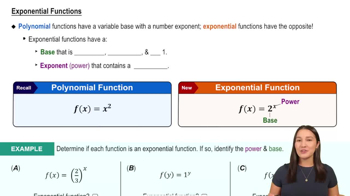
Exponential Functions

Odd Functions

A function is considered odd if it meets the condition f(-x) = -f(x) for all x in its domain. This indicates that the graph of the function is symmetric with respect to the origin. Typical examples include polynomial functions with only odd powers, such as f(x) = x³.
Recommended video:
06:21
Properties of Functions

Trigonometric Functions

Trigonometric functions, such as sine and cosine, have specific properties regarding their symmetry. The sine function is an odd function, meaning sin(-x) = -sin(x). Understanding these properties is crucial when analyzing functions like sin(x²) to determine their evenness or oddness.
Recommended video:
6:04
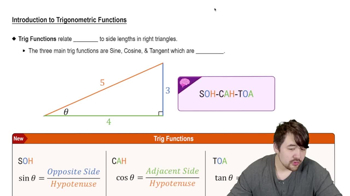
Introduction to Trigonometric Functions