Ch. 1 - Functions
Hass - Thomas' Calculus 15th Edition
Hass15th EditionThomas' CalculusISBN: 9780137616077Not the one you use?Change textbook
Chapter 1, Problem 24

Graph the functions in Exercises 23–26 in the ts-plane (t-axis horizontal, s-axis vertical). What is the period of each function? What symmetries do the graphs have?


s = −tan πt

Verified step by step guidance
1
Identify the function to be graphed: \( s = -\tan(\pi t) \). This is a transformation of the basic tangent function.
Determine the period of the function. The period of \( \tan(x) \) is \( \pi \). Since the function is \( \tan(\pi t) \), the period is \( \frac{\pi}{\pi} = 1 \).
Consider the transformations applied to the basic tangent function. The negative sign in front of the tangent function reflects the graph across the horizontal axis.
Plot key points and asymptotes. The tangent function has vertical asymptotes where the function is undefined. For \( \tan(\pi t) \), these occur at \( t = \frac{1}{2} + n \) for any integer \( n \).
Analyze symmetries. The function \( s = -\tan(\pi t) \) is an odd function, meaning it has rotational symmetry about the origin. This is because \( -\tan(\pi t) = -s \) when \( t \) is replaced by \( -t \).

Verified video answer for a similar problem:

This video solution was recommended by our tutors as helpful for the problem above.
Video duration:
10m
Was this helpful?

Key Concepts

Here are the essential concepts you must grasp in order to answer the question correctly.

Graphing Functions

Graphing functions involves plotting points on a coordinate system to visualize the relationship between variables. In this case, the functions are plotted in the ts-plane, where 't' is on the horizontal axis and 's' on the vertical axis. Understanding how to interpret the graph helps in analyzing the behavior of the function, including its periodicity and symmetries.
Recommended video:
5:53
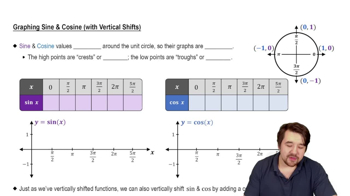
Graph of Sine and Cosine Function

Periodicity

The period of a function is the length of the interval over which the function repeats itself. For trigonometric functions like tangent, the period can be determined from the function's formula. In the case of s = -tan(πt), the period is π, meaning the function will repeat its values every π units along the t-axis.
Recommended video:
5:43
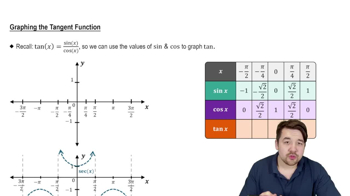
Introduction to Tangent Graph

Symmetry in Graphs

Symmetry in graphs refers to the property where a graph remains unchanged under certain transformations, such as reflection. For the function s = -tan(πt), it exhibits odd symmetry, meaning it is symmetric about the origin. This characteristic can be identified by checking if f(-t) = -f(t) holds true for the function.
Recommended video:
06:15
Graphing The Derivative