Ch. 2 - Limits
Briggs - Calculus: Early Transcendentals 3rd Edition
Briggs3rd EditionCalculus: Early TranscendentalsISBN: 9780136847243Not the one you use?Change textbook
Chapter 2, Problem 2.35

Determine the following limits. 


lim x→∞ sin x / e^x

Verified step by step guidance
1
Step 1: Understand the problem. We need to find the limit of the function \( \frac{\sin x}{e^x} \) as \( x \) approaches infinity.
Step 2: Analyze the behavior of the numerator and the denominator separately. The function \( \sin x \) oscillates between -1 and 1 for all \( x \).
Step 3: Consider the behavior of the denominator \( e^x \). As \( x \) approaches infinity, \( e^x \) grows exponentially and becomes very large.
Step 4: Apply the Squeeze Theorem. Since \( -1 \leq \sin x \leq 1 \), we have \( -\frac{1}{e^x} \leq \frac{\sin x}{e^x} \leq \frac{1}{e^x} \).
Step 5: Evaluate the limits of the bounding functions. As \( x \to \infty \), both \( \frac{1}{e^x} \to 0 \) and \( -\frac{1}{e^x} \to 0 \). By the Squeeze Theorem, \( \lim_{x \to \infty} \frac{\sin x}{e^x} = 0 \).

Verified video answer for a similar problem:

This video solution was recommended by our tutors as helpful for the problem above.
Video duration:
2m
Was this helpful?

Key Concepts

Here are the essential concepts you must grasp in order to answer the question correctly.

Limits at Infinity

Limits at infinity involve evaluating the behavior of a function as the input approaches infinity. In this context, we analyze how the function behaves as x becomes very large, which can reveal whether the function approaches a specific value, diverges, or oscillates.
Recommended video:
05:50
One-Sided Limits

Behavior of Sinusoidal Functions

The sine function oscillates between -1 and 1 for all real numbers. This bounded behavior is crucial when evaluating limits involving sine, as it indicates that despite the oscillation, the overall contribution of sin(x) becomes negligible compared to other functions that grow without bound, such as exponential functions.
Recommended video:
5:46
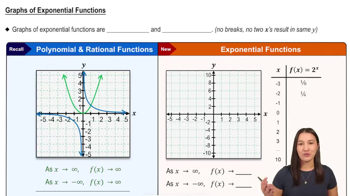
Graphs of Exponential Functions

Exponential Growth

Exponential functions, like e^x, grow significantly faster than polynomial or sinusoidal functions as x approaches infinity. This rapid growth is key in limit problems, as it often leads to the conclusion that terms involving e^x will dominate the behavior of the limit, driving the overall limit towards zero when combined with bounded functions.
Recommended video:
6:13
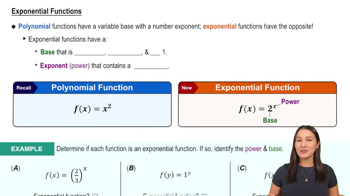
Exponential Functions