Ch. 4 - Applications of Derivatives
Hass - Thomas' Calculus 15th Edition
Hass15th EditionThomas' CalculusISBN: 9780137616077Not the one you use?Change textbook
Chapter 4, Problem 4.6.26

[Technology Exercises] When solving Exercises 14–30, you may need to use appropriate technology (such as a calculator or a computer).
26. Factoring a quartic Find the approximate values of r_1 through r_4 in the factorization
8x^4-14x^3-9x^2+11x-1=8(x-r_1)(x-r_2)(x-r_3)(x-r_4)
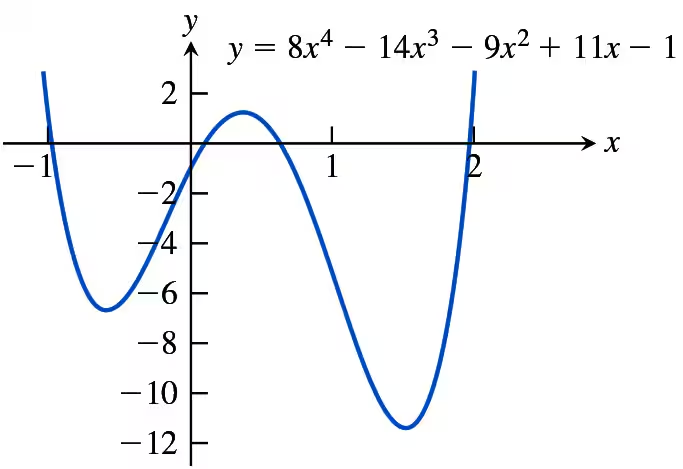
Graph of the quartic function y = 8x^4 - 14x^3 - 9x^2 + 11x - 1, showing curves and intercepts on x and y axes.

Verified step by step guidance
1
Identify the polynomial equation given: \( y = 8x^4 - 14x^3 - 9x^2 + 11x - 1 \). This is a quartic equation, which means it is a polynomial of degree 4.
To factor the quartic polynomial, we need to find its roots, \( r_1, r_2, r_3, \) and \( r_4 \). These roots are the values of \( x \) where the polynomial equals zero.
Use the graph provided to estimate the x-intercepts, which are the approximate roots of the polynomial. The graph shows where the curve crosses the x-axis.
From the graph, observe the approximate x-values where the curve crosses the x-axis. These points are the approximate roots of the polynomial.
Use a calculator or computer software to find more precise values of the roots, if necessary, by solving the equation \( 8x^4 - 14x^3 - 9x^2 + 11x - 1 = 0 \) using numerical methods such as the Newton-Raphson method or other root-finding algorithms.

Verified video answer for a similar problem:

This video solution was recommended by our tutors as helpful for the problem above.
Video duration:
10m
Was this helpful?

Key Concepts

Here are the essential concepts you must grasp in order to answer the question correctly.

Quartic Functions

A quartic function is a polynomial of degree four, which can be expressed in the form f(x) = ax^4 + bx^3 + cx^2 + dx + e, where a, b, c, d, and e are constants and a ≠ 0. The graph of a quartic function can have up to four real roots, and its shape can vary significantly, exhibiting behaviors such as turning points and inflection points.
Recommended video:
06:21
Properties of Functions

Factoring Polynomials

Factoring polynomials involves expressing a polynomial as a product of simpler polynomials or linear factors. For a quartic polynomial, this means finding values r_1, r_2, r_3, and r_4 such that the polynomial can be written as a product of the form a(x - r_1)(x - r_2)(x - r_3)(x - r_4). This process is essential for solving polynomial equations and understanding their roots.
Recommended video:
6:04
Introduction to Polynomial Functions

Roots and Intercepts

The roots of a polynomial are the values of x for which the polynomial equals zero, corresponding to the x-intercepts of its graph. In the context of the quartic function given, finding the approximate values of r_1 through r_4 involves determining where the graph intersects the x-axis. These roots are crucial for understanding the behavior of the polynomial and its factorization.
Recommended video:
Guided course
3:56
Slope-Intercept Form