Ch. 2 - Limits and Continuity
Hass - Thomas' Calculus 15th Edition
Hass15th EditionThomas' CalculusISBN: 9780137616077Not the one you use?Change textbook
Chapter 2, Problem 2.6.1h

Finding Limits


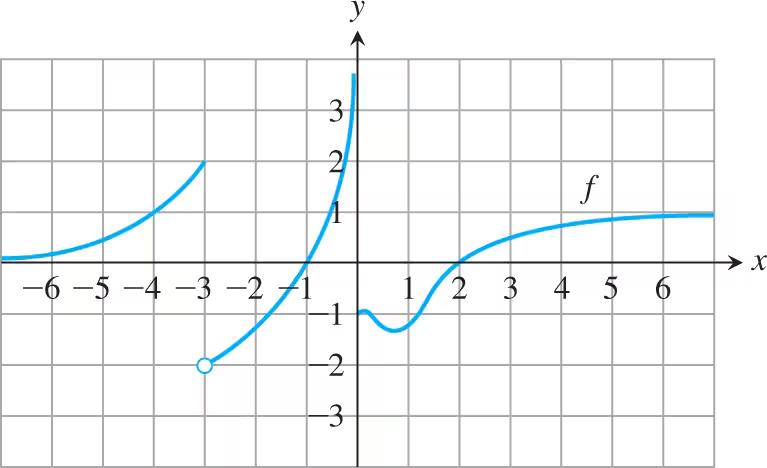
For the function f whose graph is given, determine the following limits. Write ∞ or −∞ where appropriate.


h. lim x → ∞ f(x)


Verified step by step guidance
1
Observe the graph of the function f(x) as x approaches infinity. This means we are interested in the behavior of the function as x moves towards the right on the x-axis.
Identify the trend of the function f(x) for large values of x. Notice that as x increases, the graph of the function appears to level off and approach a horizontal line.
Determine the y-value that the function is approaching as x goes to infinity. This is the horizontal asymptote of the function.
From the graph, it appears that the function f(x) approaches a constant value as x becomes very large. This constant value is the limit of the function as x approaches infinity.
Conclude that the limit of f(x) as x approaches infinity is the y-value of the horizontal asymptote observed in the graph.

Verified video answer for a similar problem:

This video solution was recommended by our tutors as helpful for the problem above.
Video duration:
1m
Was this helpful?

Key Concepts

Here are the essential concepts you must grasp in order to answer the question correctly.

Limits at Infinity

Limits at infinity describe the behavior of a function as the input approaches positive or negative infinity. This concept helps determine whether the function approaches a specific value, diverges to infinity, or oscillates. Understanding limits at infinity is crucial for analyzing the end behavior of functions, particularly rational functions and those with asymptotes.
Recommended video:
03:07
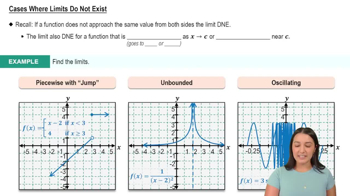
Cases Where Limits Do Not Exist

Vertical Asymptotes

Vertical asymptotes occur when the function approaches infinity or negative infinity as the input approaches a certain value. This typically happens at points where the function is undefined, such as division by zero. Identifying vertical asymptotes is essential for understanding the overall shape of the graph and the limits of the function near those points.
Recommended video:
3:40
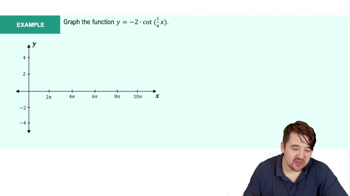
Introduction to Cotangent Graph Example 1

Continuous Functions

A function is continuous if there are no breaks, jumps, or holes in its graph. For limits, continuity ensures that the limit of the function as it approaches a point equals the function's value at that point. Understanding continuity is vital for evaluating limits, especially when determining the behavior of functions at specific points or as they approach infinity.
Recommended video:
05:34
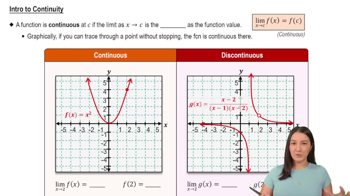
Intro to Continuity