
Textbook Question
15–48. Derivatives Find the derivative of the following functions.
P = 40/1+2^-t
232
views

 Verified step by step guidance
 05:14
05:14
 05:02
05:02 04:22
04:2215–48. Derivatives Find the derivative of the following functions.
P = 40/1+2^-t
Orthogonal trajectories Two curves are orthogonal to each other if their tangent lines are perpendicular at each point of intersection (recall that two lines are perpendicular to each other if their slopes are negative reciprocals). A family of curves forms orthogonal trajectories with another family of curves if each curve in one family is orthogonal to each curve in the other family. For example, the parabolas y = cx² form orthogonal trajectories with the family of ellipses x²+2y² = k, where c and k are constants (see figure).
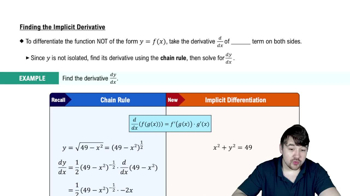
Find dy/dx for each equation of the following pairs. Use the derivatives to explain why the families of curves form orthogonal trajectories. <IMAGE>
y = cx²; x²+2y² = k, where c and k are constants
Vertical tangent lines If a function f is continuous at a and lim x→a| f′(x)|=∞, then the curve y=f(x) has a vertical tangent line at a, and the equation of the tangent line is x=a. If a is an endpoint of a domain, then the appropriate one-sided derivative (Exercises 71–72) is used. Use this information to answer the following questions.
Graph the following curves and determine the location of any vertical tangent lines.
a. x²+y² = 9
If f is a one-to-one function with f(3)=8 and f′(3)=7, find the equation of the line tangent to y=f^−1(x) at x=8.
27–76. Calculate the derivative of the following functions.
9–61. Evaluate and simplify y'.
y = (2x−3)x^3/2