Ch. 1 - Functions
Briggs - Calculus: Early Transcendentals 3rd Edition
Briggs3rd EditionCalculus: Early TranscendentalsISBN: 9780136847243Not the one you use?Change textbook
Chapter 1, Problem 1.1.68

Simplify the difference quotient ƒ(x+h)-ƒ(x)/h
ƒ(x) = (x)/(x+1)

Verified step by step guidance
1
First, understand the difference quotient: it is a formula used to approximate the derivative of a function. The general form is (f(x+h) - f(x)) / h.
Identify the function f(x) given in the problem, which is f(x) = x / (x + 1).
Calculate f(x + h) by substituting x + h into the function: f(x + h) = (x + h) / (x + h + 1).
Substitute f(x + h) and f(x) into the difference quotient formula: ((x + h) / (x + h + 1) - x / (x + 1)) / h.
Simplify the expression by finding a common denominator for the fractions in the numerator, then simplify the entire expression step by step, focusing on algebraic manipulation to reduce the complexity.

Verified video answer for a similar problem:

This video solution was recommended by our tutors as helpful for the problem above.
Video duration:
4m
Was this helpful?

Key Concepts

Here are the essential concepts you must grasp in order to answer the question correctly.

Difference Quotient

The difference quotient is a formula used to calculate the average rate of change of a function over an interval. It is expressed as (ƒ(x+h) - ƒ(x))/h, where h represents a small change in x. This concept is fundamental in calculus as it leads to the definition of the derivative, which measures the instantaneous rate of change.
Recommended video:
06:43
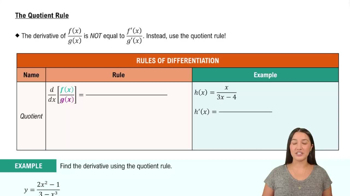
The Quotient Rule

Function Evaluation

Function evaluation involves substituting a specific value into a function to determine its output. In this case, we need to evaluate the function ƒ(x) = x/(x+1) at both x and x+h. Understanding how to correctly substitute and simplify expressions is crucial for manipulating the difference quotient.
Recommended video:
4:26
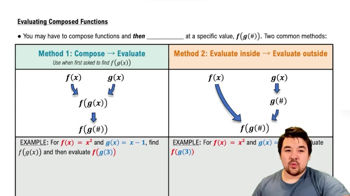
Evaluating Composed Functions

Simplification Techniques

Simplification techniques in algebra involve reducing expressions to their simplest form, often by factoring, combining like terms, or canceling common factors. In the context of the difference quotient, applying these techniques will help in simplifying the expression after substituting ƒ(x+h) and ƒ(x), making it easier to analyze the limit as h approaches zero.
Recommended video:
05:03
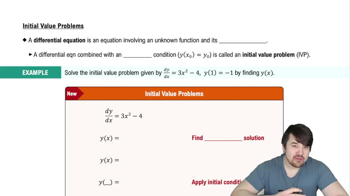
Initial Value Problems