Ch. 4 - Applications of Derivatives
Hass - Thomas' Calculus 15th Edition
Hass15th EditionThomas' CalculusISBN: 9780137616077Not the one you use?Change textbook
Chapter 4, Problem 31a

Finding Functions from Derivatives


In Exercises 31–36, find all possible functions with the given derivative.


a. y′ = x

Verified step by step guidance
1
To find the original function from its derivative, we need to perform integration. The given derivative is \( y' = x \).
Integrate the derivative \( y' = x \) with respect to \( x \). This means we need to find \( \int x \, dx \).
The integral of \( x \) with respect to \( x \) is \( \frac{x^2}{2} \). This is because the power rule for integration states that \( \int x^n \, dx = \frac{x^{n+1}}{n+1} + C \), where \( C \) is the constant of integration.
After integrating, we have \( y = \frac{x^2}{2} + C \), where \( C \) is an arbitrary constant. This represents the family of functions whose derivative is \( x \).
The constant \( C \) can be any real number, which means there are infinitely many functions that satisfy the given derivative, each differing by a constant.

Verified video answer for a similar problem:

This video solution was recommended by our tutors as helpful for the problem above.
Video duration:
2m
Was this helpful?

Key Concepts

Here are the essential concepts you must grasp in order to answer the question correctly.

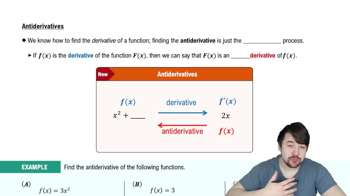
Antiderivatives

An antiderivative of a function is another function whose derivative is the original function. To find a function from its derivative, you need to determine its antiderivative. For example, if y' = x, the antiderivative of x is (1/2)x^2 plus a constant C, representing all possible functions with the given derivative.
Recommended video:
05:50
Antiderivatives

Integration

Integration is the process of finding the antiderivative of a function. It involves calculating the integral of the function, which can be indefinite or definite. In this context, finding the indefinite integral of y' = x will yield the general form of the function y = (1/2)x^2 + C, where C is an arbitrary constant.
Recommended video:
05:04
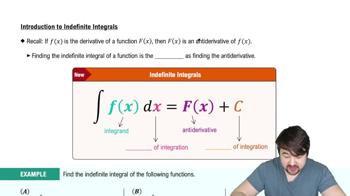
Introduction to Indefinite Integrals

Constant of Integration

The constant of integration, denoted as C, arises when computing indefinite integrals. It represents an infinite number of possible functions that differ by a constant. When finding functions from derivatives, this constant accounts for all vertical shifts of the antiderivative, ensuring the solution encompasses all possible functions with the given derivative.
Recommended video:
05:04
Introduction to Indefinite Integrals