

Angle to a particle (part 2) The figure in Exercise 81 shows the particle traveling away from the sensor, which may have influenced your solution (we expect you used the inverse sine function). Suppose instead that the particle approaches the sensor (see figure). How would this change the solution? Explain the differences in the two answers. <IMAGE>
Ch. 3 - Derivatives
Briggs3rd EditionCalculus: Early TranscendentalsISBN: 9780136847243Not the one you use?Change textbook
Chapter 3, Problem 3.8.12
Consider the curve x=e^y. Use implicit differentiation to verify that dy/dx = e^-y and then find d²y/dx² .
Verified step by step guidance1
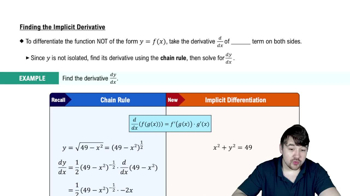
Start by differentiating both sides of the equation x = e^y with respect to x. This requires using implicit differentiation since y is a function of x.
Differentiate the left side: The derivative of x with respect to x is 1.
Differentiate the right side: Use the chain rule. The derivative of e^y with respect to y is e^y, and then multiply by dy/dx because of the chain rule. So, the derivative is e^y * (dy/dx).
Set the derivatives equal: 1 = e^y * (dy/dx). Solve for dy/dx by dividing both sides by e^y, giving dy/dx = 1/e^y, which simplifies to e^-y.
To find d²y/dx², differentiate dy/dx = e^-y with respect to x again. Use the chain rule: the derivative of e^-y with respect to y is -e^-y, and multiply by dy/dx. Substitute dy/dx = e^-y into this expression to find d²y/dx².

Verified video answer for a similar problem:
This video solution was recommended by our tutors as helpful for the problem above.
Video duration:
5mWas this helpful?
Key Concepts
Here are the essential concepts you must grasp in order to answer the question correctly.
Implicit Differentiation
Implicit differentiation is a technique used to differentiate equations where the dependent and independent variables are not explicitly separated. Instead of solving for one variable in terms of the other, we differentiate both sides of the equation with respect to the independent variable, applying the chain rule as necessary. This method is particularly useful for curves defined by equations like x = e^y, where y is not isolated.
Recommended video:
Finding The Implicit Derivative
Chain Rule
The chain rule is a fundamental principle in calculus that allows us to differentiate composite functions. It states that if a function y is defined as a function of u, which in turn is a function of x, then the derivative of y with respect to x can be found by multiplying the derivative of y with respect to u by the derivative of u with respect to x. This is essential in implicit differentiation, where we often need to differentiate y with respect to x while treating y as a function of x.
Recommended video:
Intro to the Chain Rule
Second Derivative
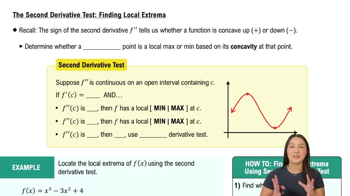
The second derivative, denoted as d²y/dx², measures the rate of change of the first derivative (dy/dx) with respect to the independent variable. It provides information about the curvature of the function and can indicate concavity or points of inflection. To find the second derivative in the context of implicit differentiation, we differentiate the first derivative again, applying the chain rule and product rule as needed to account for any dependencies between the variables.
Recommended video:
The Second Derivative Test: Finding Local Extrema
Related Practice
Textbook Question
133
views
Textbook Question
49–55. Derivatives of tower functions (or g^h) Find the derivative of each function and evaluate the derivative at the given value of a.
h (x) = x^√x; a = 4
157
views
Textbook Question
A cost function of the form C(x) = 1/2x² reflects diminishing returns to scale. Find and graph the cost, average cost, and marginal cost functions. Interpret the graphs and explain the idea of diminishing returns.
202
views
Textbook Question
Find an equation of the line tangent to the curve y = sin x at x = 0.
352
views
Textbook Question
Derivatives Find and simplify the derivative of the following functions.
g(t) = 3t² + 6/t⁷
434
views
Textbook Question
Find the slope of the curve y=sin-1 x at (1/2, π/6) without calculating the derivative of sin-1 x.
177
views
