Ch. 1 - Functions
Hass - Thomas' Calculus 15th Edition
Hass15th EditionThomas' CalculusISBN: 9780137616077Not the one you use?Change textbook
Chapter 1, Problem 1.3.54

Solving Trigonometric Equations


For Exercises 51–54, solve for the angle θ, where 0 ≤ θ ≤ 2π.


sin² θ = cos² θ

Verified step by step guidance
1
Start by recognizing the given equation: sin² θ = cos² θ. This can be rewritten using the identity sin² θ + cos² θ = 1.
Rearrange the identity to express one trigonometric function in terms of the other: sin² θ = 1 - cos² θ.
Substitute this expression into the original equation: 1 - cos² θ = cos² θ.
Combine like terms to form a single equation: 1 = 2cos² θ.
Solve for cos² θ by dividing both sides by 2, then take the square root to find the possible values of cos θ. Consider the range 0 ≤ θ ≤ 2π to determine the specific angles that satisfy the equation.

Verified video answer for a similar problem:

This video solution was recommended by our tutors as helpful for the problem above.
Video duration:
5m
Was this helpful?

Key Concepts

Here are the essential concepts you must grasp in order to answer the question correctly.

Trigonometric Identities

Trigonometric identities are equations that involve trigonometric functions and are true for all values of the variables involved. A key identity relevant to the given equation is the Pythagorean identity, which states that sin² θ + cos² θ = 1. Understanding these identities is crucial for simplifying and solving trigonometric equations.
Recommended video:
7:17
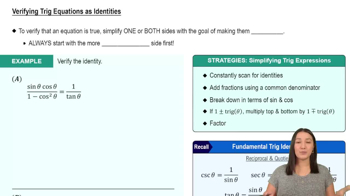
Verifying Trig Equations as Identities

Solving Trigonometric Equations

Solving trigonometric equations involves finding the angles that satisfy the equation within a specified interval. In this case, we need to manipulate the equation sin² θ = cos² θ to find the values of θ between 0 and 2π. Techniques often include using identities, factoring, and applying inverse trigonometric functions.
Recommended video:
5:02
Solving Logarithmic Equations

Unit Circle

The unit circle is a fundamental concept in trigonometry that provides a geometric interpretation of the sine and cosine functions. It is a circle with a radius of one centered at the origin of a coordinate plane. Understanding the unit circle helps in determining the angles corresponding to specific sine and cosine values, which is essential for solving the equation sin² θ = cos² θ.
Recommended video:
5:10
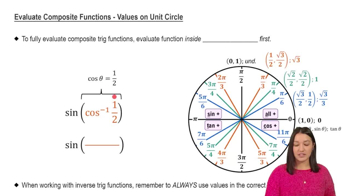
Evaluate Composite Functions - Values on Unit Circle