Use limits to determine the equations for all vertical asymptotes.
x² + x ― 6 c. y = ------------------ x² + 2x ― 8
Verified step by step guidance
1
Step 1: Identify the vertical asymptotes by setting the denominator equal to zero. Solve the equation \(x^2 + 2x - 8 = 0\) to find the values of \(x\) where the function is undefined.
Step 2: Factor the quadratic equation \(x^2 + 2x - 8\) to find its roots. This can be done by finding two numbers that multiply to -8 and add to 2.
Step 3: Once the roots are found, these values of \(x\) are the vertical asymptotes. Use limits to confirm that the function approaches infinity as \(x\) approaches these values from either side.
Step 4: To find horizontal asymptotes, compare the degrees of the numerator and the denominator. Since both are quadratic, divide the leading coefficients of \(x^2\) terms.
Step 5: Use limits to verify the horizontal asymptote by evaluating \(\lim_{x \to \infty} \frac{x^2 + x - 6}{x^2 + 2x - 8}\) and \(\lim_{x \to -\infty} \frac{x^2 + x - 6}{x^2 + 2x - 8}\).
Verified video answer for a similar problem:
This video solution was recommended by our tutors as helpful for the problem above
Video duration:
3m
Play a video:
0 Comments
Key Concepts
Here are the essential concepts you must grasp in order to answer the question correctly.
Vertical Asymptotes
Vertical asymptotes occur in a rational function when the denominator approaches zero while the numerator does not. This indicates that the function's value increases or decreases without bound as it approaches a specific x-value. To find vertical asymptotes, we set the denominator equal to zero and solve for x.
Limits are a fundamental concept in calculus that describe the behavior of a function as it approaches a particular point. They are essential for analyzing the values of functions near points of discontinuity, such as vertical asymptotes. By evaluating limits, we can determine the function's behavior as it approaches the asymptote from either side.
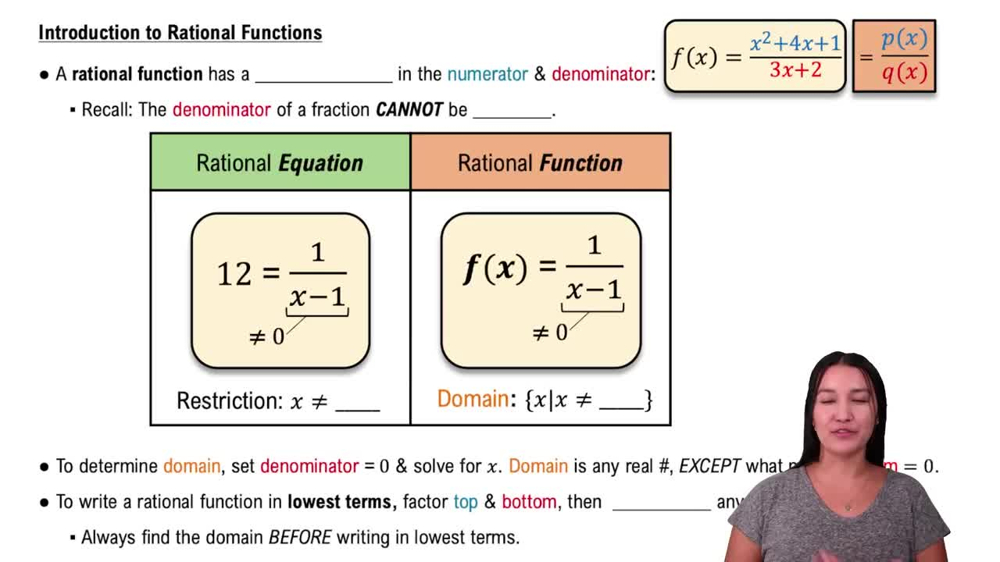
Rational functions are expressions formed by the ratio of two polynomials. They can exhibit unique behaviors, such as vertical and horizontal asymptotes, depending on the degrees of the numerator and denominator. Understanding the structure of rational functions is crucial for identifying asymptotes and analyzing their limits.

 3:32 minutes
 Verified step by step guidance
 3:40
3:40