Ch. 3 - Derivatives
Briggs - Calculus: Early Transcendentals 3rd Edition
Briggs3rd EditionCalculus: Early TranscendentalsISBN: 9780136847243Not the one you use?Change textbook
Chapter 3, Problem 39a

Find the derivative function f' for the following functions f.
f(x) = 2/3x+1; a= -1

Verified step by step guidance
1
Step 1: Identify the function f(x) = \(\frac{2}{3}\)x + 1. This is a linear function of the form f(x) = ax + b, where a = \(\frac{2}{3}\) and b = 1.
Step 2: Recall that the derivative of a linear function f(x) = ax + b is simply the coefficient of x, which is a. In this case, the derivative f'(x) will be \(\frac{2}{3}\).
Step 3: Since the derivative of a constant is zero, the +1 in the function does not affect the derivative. Therefore, f'(x) = \(\frac{2}{3}\).
Step 4: Evaluate the derivative at the given point a = -1. Since the derivative is constant, f'(-1) = \(\frac{2}{3}\).
Step 5: Conclude that the derivative function f'(x) is constant and equal to \(\frac{2}{3}\) for all x, including at x = -1.

Verified video answer for a similar problem:

This video solution was recommended by our tutors as helpful for the problem above.
Video duration:
3m
Was this helpful?

Key Concepts

Here are the essential concepts you must grasp in order to answer the question correctly.

Derivative

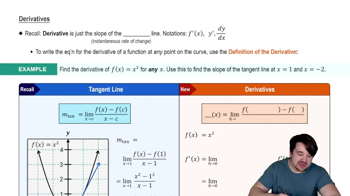
The derivative of a function measures how the function's output value changes as its input value changes. It is defined as the limit of the average rate of change of the function over an interval as the interval approaches zero. The derivative is often denoted as f'(x) and represents the slope of the tangent line to the function's graph at any given point.
Recommended video:
05:44
Derivatives

Power Rule

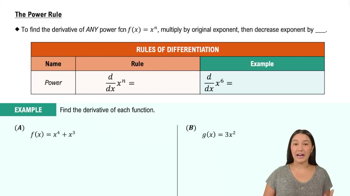
The Power Rule is a fundamental technique for finding derivatives of polynomial functions. It states that if f(x) = x^n, where n is a real number, then the derivative f'(x) = n*x^(n-1). This rule simplifies the process of differentiation, especially for functions that can be expressed in polynomial form.
Recommended video:

Constant Rule

The Constant Rule states that the derivative of a constant is zero. This means that if a function f(x) is a constant value, its rate of change is zero, indicating that the function does not change regardless of the input. This rule is essential when differentiating functions that include constant terms.
Recommended video:
04:02
The Power Rule