In Exercises 1–6, find the domain and range of each function.
f(x) = 1 + x²
Verified step by step guidance
1
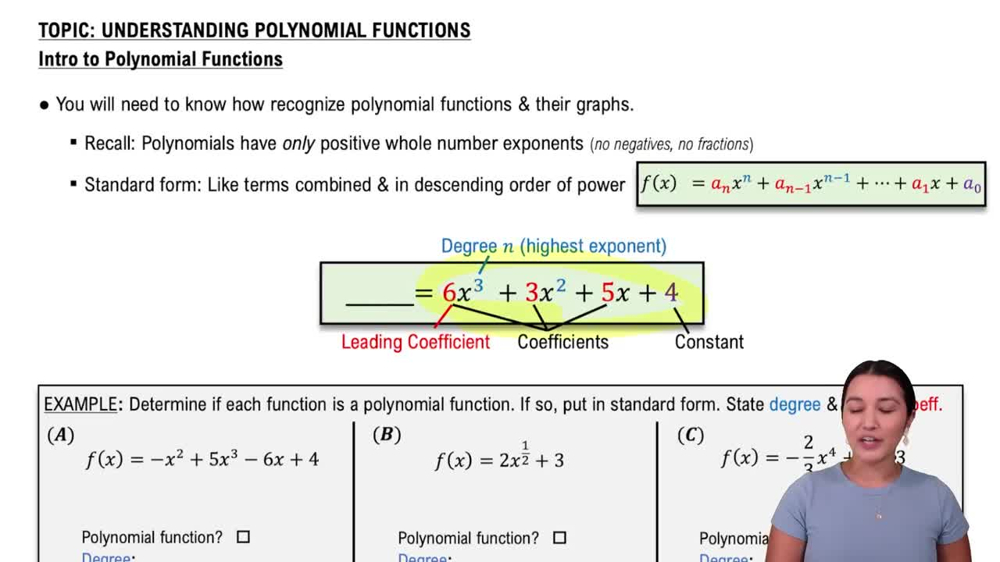
Step 1: Understand the function f(x) = 1 + x². This is a quadratic function, which is a type of polynomial function.
Step 2: Determine the domain of the function. Since f(x) = 1 + x² is a polynomial function, it is defined for all real numbers. Therefore, the domain is all real numbers, which can be expressed as (-∞, ∞).
Step 3: Analyze the range of the function. The expression x² is always non-negative, meaning it is greater than or equal to 0 for all real x.
Step 4: Since x² is non-negative, the smallest value of f(x) = 1 + x² occurs when x² = 0, which gives f(x) = 1. Therefore, the range starts at 1.
Step 5: As x increases or decreases without bound, x² becomes very large, and consequently, f(x) = 1 + x² also becomes very large. Thus, the range of the function is [1, ∞).
Verified video answer for a similar problem:
This video solution was recommended by our tutors as helpful for the problem above
Video duration:
2m
Play a video:
0 Comments
Key Concepts
Here are the essential concepts you must grasp in order to answer the question correctly.
Domain of a Function
The domain of a function refers to the set of all possible input values (x-values) for which the function is defined. For the function f(x) = 1 + x², the domain includes all real numbers since there are no restrictions on x that would make the function undefined.
The range of a function is the set of all possible output values (y-values) that the function can produce. In the case of f(x) = 1 + x², the output is always greater than or equal to 1, as x² is non-negative. Thus, the range is [1, ∞).
Quadratic functions are polynomial functions of degree two, typically expressed in the form f(x) = ax² + bx + c. The function f(x) = 1 + x² is a specific type of quadratic function where a = 1, b = 0, and c = 1, which opens upwards and has a vertex at the point (0, 1).

 2:26 minutes
 Verified step by step guidance

 5:10
5:10