
Ch. 56 - Conservation Biology and Global Change
Campbell - Campbell Biology 11th Edition
Urry11th EditionCampbell BiologyISBN: 9789357423311Not the one you use?Change textbook
Chapter 56, Problem 5

Which of the following strategies would most rapidly increase the genetic diversity of a population in an extinction vortex?
a. Establish a reserve that protects the population's habitat
b. Introduce new individuals transported from other populations of the same species
c. Sterilize the least fit individuals in the population
d. Control populations of the endangered population's predators and competitors

Verified step by step guidance
1
Understand the concept of an extinction vortex: It is a situation where a population's size decreases to a point where genetic diversity is lost, leading to further decline and potential extinction.
Identify the importance of genetic diversity: Genetic diversity is crucial for the survival and adaptability of a population, as it allows for a wider range of traits that can help individuals survive changing environments.
Evaluate the options provided: Consider which strategy directly increases genetic diversity. Establishing a reserve (option a) protects habitat but doesn't directly increase genetic diversity. Sterilizing individuals (option c) reduces population size and diversity. Controlling predators (option d) may help survival but doesn't increase genetic diversity.
Focus on option b: Introducing new individuals from other populations can rapidly increase genetic diversity by adding new genetic material to the population, which can help counteract the effects of an extinction vortex.
Conclude that option b is the most effective strategy for rapidly increasing genetic diversity, as it directly introduces new genetic material into the population.

Verified video answer for a similar problem:

This video solution was recommended by our tutors as helpful for the problem above.
Video duration:
1m
Was this helpful?

Key Concepts

Here are the essential concepts you must grasp in order to answer the question correctly.

Genetic Diversity

Genetic diversity refers to the total number of genetic characteristics in the genetic makeup of a species. It is crucial for the survival and adaptability of a population, as it allows for greater resilience to environmental changes and diseases. Increasing genetic diversity can help prevent extinction by enhancing the population's ability to adapt to new challenges.
Recommended video:
02:37
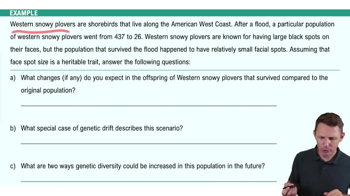
Genetic Drift Example 2

Extinction Vortex

An extinction vortex is a process where a population's size and genetic diversity decrease, leading to further declines in population size and genetic health. This cycle can result in extinction if not interrupted. Factors contributing to an extinction vortex include habitat loss, inbreeding, and environmental changes, which reduce the population's ability to survive and reproduce.
Recommended video:
04:48
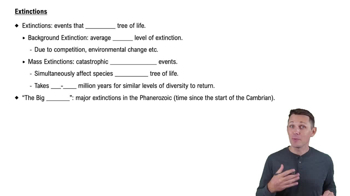
Extinctions

Gene Flow

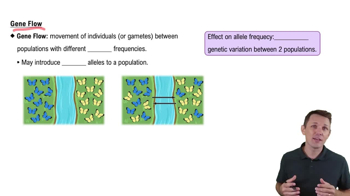
Gene flow is the transfer of genetic material between separate populations. It is a key mechanism for increasing genetic diversity, as it introduces new alleles into a population. In the context of conservation, introducing individuals from other populations can enhance genetic diversity and help populations escape an extinction vortex by increasing their genetic variability and adaptive potential.
Recommended video:
01:43
Gene Flow
Related Practice
Textbook Question

The main cause of the increase in the amount of CO₂ in Earth's atmosphere over the past 150 years is

a. Increased worldwide primary production

b. Increased worldwide standing crop

c. An increase in the amount of infrared radiation absorbed by the atmosphere

d. The burning of larger amounts of wood and fossil fuels

1325
views
Textbook Question

What is the single greatest threat to biodiversity?

a. Overharvesting of commercially important species

b. Habitat alteration, fragmentation, and destruction

c. Introduced species that compete with native species

d. Novel pathogens

1227
views
Textbook Question

Which of these is a consequence of biological magnification?

a. Toxic chemicals in the environment pose greater risk to top-level predators than to primary consumers.

b. Populations of top-level predators are generally smaller than populations of primary consumers.

c. The biomass of producers in an ecosystem is generally higher than the biomass of primary consumers.

d. Only a small portion of the energy captured by producers is transferred to consumers.

839
views
Textbook Question

Of the following statements about protected areas that have been established to preserve biodiversity, which one is not correct?

a. About 25% of Earth's land area is now protected.

b. National parks are one of many types of protected areas.

c. Management of a protected area should be coordinated with management of the land surrounding the area.

d. It is especially important to protect biodiversity hot spots.

993
views