Ch. 38 - Angiosperm Reproduction and Biotechnology
Campbell - Campbell Biology 11th Edition
Urry11th EditionCampbell BiologyISBN: 9789357423311Not the one you use?Change textbook
Chapter 38, Problem 2

Double fertilization means that:
a. Flowers must be pollinated twice to yield fruits and seeds
b. Every egg must receive two sperm to produce an embryo
c. One sperm is needed to fertilize the egg, and a second sperm is needed to fertilize the polar nuclei
d. Every sperm has two nuclei

Verified step by step guidance
1
Understand the concept of double fertilization, which is a unique process in angiosperms (flowering plants) where two fertilization events occur within the ovule.
Recognize that in double fertilization, one sperm cell fertilizes the egg cell, forming a diploid zygote, which will develop into the embryo.
Identify that the second sperm cell fuses with the two polar nuclei in the central cell of the ovule, forming a triploid cell, which will develop into the endosperm, a tissue that provides nourishment to the developing embryo.
Eliminate options that do not align with the process of double fertilization: Option a is incorrect because pollination is separate from fertilization. Option b is incorrect because each egg is fertilized by one sperm. Option d is incorrect because sperm cells do not have two nuclei.
Conclude that the correct answer is option c, as it accurately describes the two distinct fertilization events in double fertilization: one sperm fertilizes the egg, and the other fertilizes the polar nuclei.

Verified video answer for a similar problem:

This video solution was recommended by our tutors as helpful for the problem above.
Video duration:
2m
Was this helpful?

Key Concepts

Here are the essential concepts you must grasp in order to answer the question correctly.

Double Fertilization

Double fertilization is a unique process in angiosperms where two sperm cells are involved in fertilization. One sperm fertilizes the egg cell, forming a zygote, while the other sperm fuses with two polar nuclei to form the triploid endosperm, which nourishes the developing embryo. This process ensures efficient use of resources for seed development.
Recommended video:
Guided course
07:44
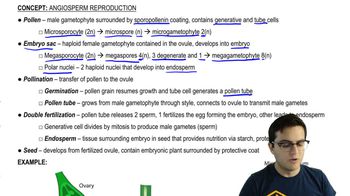
Double Fertilization

Role of Sperm Cells in Double Fertilization

In double fertilization, two sperm cells play distinct roles. The first sperm cell fertilizes the egg cell, resulting in the formation of a diploid zygote, which will develop into the embryo. The second sperm cell fuses with the two polar nuclei in the central cell of the ovule, forming a triploid cell that develops into the endosperm, providing nutrition to the growing embryo.
Recommended video:
Guided course
07:44
Double Fertilization

Polar Nuclei

Polar nuclei are two haploid nuclei located in the central cell of the ovule in flowering plants. During double fertilization, one of the sperm cells fuses with these polar nuclei to form a triploid cell, which becomes the endosperm. The endosperm is crucial for providing nutrients to the developing embryo, supporting its growth and development within the seed.
Recommended video:
Guided course
06:59
Polar Covalent Bonds