Skip to main content
General Biology
My Course
Learn
Exam Prep
AI Tutor
Study Guides
Textbook Solutions
Flashcards
Explore
My Course
Learn
Exam Prep
AI Tutor
Study Guides
Textbook Solutions
Flashcards
Explore
Back
Innate Immunity exam
1 student found this helpful
You can tap to flip the card.
Define:
Innate Immune System
You can tap to
flip the card.
👆
Innate Immune System
The body's first line of defense against pathogens, employing a nonspecific response.
Track progress
Control buttons has been changed to "navigation" mode.
1/29
Related flashcards
Related practice
Recommended videos
Guided course
05:20
Innate Immune Response
Jason
2995
views
23
rank
1
comments
Guided course
06:47
Innate Immune Cells
Jason
2565
views
17
rank
2
comments
Guided course
03:06
Inflammatory Response
Jason
2318
views
18
rank
Terms in this set (29)
Hide definitions
Innate Immune System
The body's first line of defense against pathogens, employing a nonspecific response.
What is the role of the skin in the innate immune system?
Acts as a physical barrier to protect the body from pathogens.
Mucus
A slimy secretion that traps foreign invaders and contains antimicrobial enzymes.
What are leukocytes?
White blood cells that initiate the innate immune response.
Phagocytosis
The process by which phagocytes engulf and digest pathogens.
Pattern Recognition Receptors (PRRs)
Membrane receptors that identify pathogen-associated molecular patterns (PAMPs).
What do Toll-like receptors (TLRs) do?
They identify PAMPs and initiate a signaling cascade to recruit other immune cells.
Inflammatory Response
A response characterized by swelling and recruitment of immune cells to combat infections.
Complement System
A system of proteins that aids in lysing pathogens and enhancing immune defense.
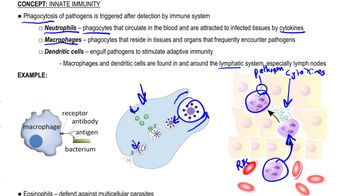
What is the function of neutrophils?
Phagocytes that circulate in the blood and are attracted to infected tissues by cytokines.
Macrophages
Phagocytes that reside in tissues and organs, defending against pathogens.
What is the role of dendritic cells?
Phagocytes that stimulate the adaptive immune system by presenting antigens.
Eosinophils
Immune cells that defend against multicellular parasites.
Natural Killer Cells
Cells that identify and destroy virus-infected cells by triggering apoptosis.
What are interferons?
Cytokines that induce cells to interfere with viral replication.
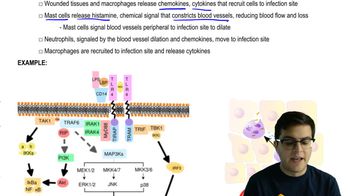
Chemokines
A type of cytokine that recruits cells to the infection site.
What do mast cells release?
Histamine, which constricts blood vessels to reduce blood flow and prevent blood loss.
Cytokines
Signaling molecules that attract other immune cells and help mount an immune response.
What is the role of lysozymes?
Enzymes that break down bacterial cell walls.
Pathogen-Associated Molecular Patterns (PAMPs)
Molecules commonly displayed by pathogens that are recognized by the immune system.
What is the function of TLR4?
Recognizes lipopolysaccharides from bacteria and releases cytokines in response.
Histamine
A chemical signal released by mast cells that constricts blood vessels in the area of infection.
What is the role of the complement proteins?
Form pores in the membranes of pathogens, causing them to lyse.
Neutrophils
Phagocytes that circulate in the blood and are attracted to infected tissues by cytokines.
What is the purpose of the inflammatory response?
To recruit immune cells to the site of infection and combat pathogens.
Lipopolysaccharides (LPS)
A type of PAMP found on the surface of bacterial cells.
What do chemokines do?
Recruit immune cells to the site of infection.
Phagocytes
Cells that perform phagocytosis to eliminate pathogens.
What is the role of cytokines in the immune response?
They attract other immune cells and help mount an immune response.
 BackBack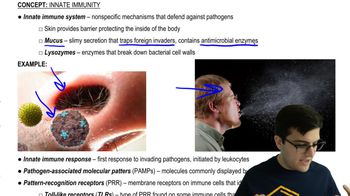
 05:20
05:20