Skip to main content
General Biology
My Course
Learn
Exam Prep
AI Tutor
Study Guides
Textbook Solutions
Flashcards
Explore
My Course
Learn
Exam Prep
AI Tutor
Study Guides
Textbook Solutions
Flashcards
Explore
Back
Enzyme Binding Factors exam
You can tap to flip the card.
Define:
Active Site
You can tap to
flip the card.
👆
Active Site
A specific region of an enzyme where the substrate binds.
Track progress
Control buttons has been changed to "navigation" mode.
1/29
Related flashcards
Related practice
Recommended videos
Enzyme Binding Factors definitions
Enzyme Binding Factors
10 Terms
Enzyme Binding Factors quiz #1
Enzyme Binding Factors
15 Terms
Enzyme Binding Factors
7. Energy and Metabolism
5 problems
Topic
Jason
Enzyme Inhibition
7. Energy and Metabolism
4 problems
Topic
Jason
7. Energy and Metabolism
10 topics
13 problems
Chapter
Brendan
Guided course
03:49
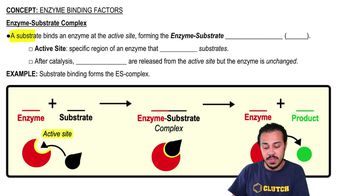
Enzyme-Substrate Complex
Jason
13713
views
192
rank
1
comments
Guided course
04:22
Cofactors
Jason
12535
views
142
rank
Terms in this set (29)
Hide definitions
Active Site
A specific region of an enzyme where the substrate binds.
What is the enzyme-substrate complex?
It is the complex formed when a substrate binds to the active site of an enzyme, abbreviated as ES.
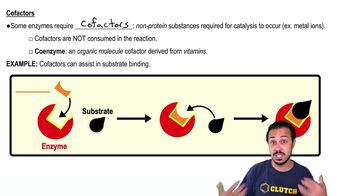
Cofactors
Non-protein substances required by some enzymes for catalysis.
What happens to the enzyme after catalysis?
The enzyme remains unchanged and can catalyze further reactions.
Coenzymes
Organic molecule cofactors derived from vitamins.
What role do cofactors play in enzyme activity?
They assist in catalysis, often by enhancing substrate binding.
Enzyme
A protein that catalyzes chemical reactions without being consumed.
What is the abbreviation for the enzyme-substrate complex?
ES
Metal Ions
A type of cofactor that is not made of amino acids.
What is the role of the active site in an enzyme?
It binds the substrate to form the enzyme-substrate complex.
Substrate
The reactant that an enzyme acts upon.
What is a coenzyme?
A specific type of cofactor that is an organic molecule.
Products
The substances formed from the substrate after catalysis.
How do cofactors assist enzymes?
By binding to the active site and making it better suited for the substrate.
Enzyme Catalysis
The process by which an enzyme converts substrates into products.
What is the function of coenzymes?
They enhance substrate binding and ensure effective enzyme activity.
Non-protein Substances
Cofactors required by some enzymes for catalysis.
What happens to cofactors during the reaction?
They are not consumed and remain unchanged.
Metabolic Pathways
Series of chemical reactions in a cell, facilitated by enzymes.
What is the significance of the enzyme remaining unchanged?
It allows the enzyme to catalyze multiple reactions repeatedly.
Vitamins
Nutrient sources from which coenzymes are derived.
What is the abbreviation for products in enzyme reactions?
P
Enzyme-Substrate Complex (ES)
The intermediate formed when a substrate binds to an enzyme's active site.
How do metal ions function as cofactors?
They assist in enzyme catalysis without being part of the protein structure.
Catalysis
The acceleration of a chemical reaction by a catalyst.
What is the role of the active site in enzyme catalysis?
It is where the substrate binds and the reaction is facilitated.
Enzyme Functionality
The ability of an enzyme to catalyze reactions, often influenced by cofactors.
What are the products of enzyme catalysis?
The substances formed from the substrate, abbreviated as P.
Substrate Binding
The process of a substrate attaching to the enzyme's active site.
 BackBack

 03:49
03:49