Skip to main content
General Biology
My Course
Learn
Exam Prep
AI Tutor
Study Guides
Textbook Solutions
Flashcards
Explore
My Course
Learn
Exam Prep
AI Tutor
Study Guides
Textbook Solutions
Flashcards
Explore
Back
Chordates exam
You can tap to flip the card.
Define:
Chordates
You can tap to
flip the card.
👆
Chordates
Bilateral deuterostome animals with a dorsal hollow nerve cord, notochord, postanal tail, and pharyngeal gill slits at some point in their life cycle.
Track progress
Control buttons has been changed to "navigation" mode.
1/29
Related flashcards
Related practice
Recommended videos
Guided course
05:34
Chordates
Jason
3128
views
38
rank
Guided course
05:27
Vertebrates
Jason
2531
views
20
rank
Guided course
02:33
Jawless Fish
Jason
2519
views
18
rank
1
comments
Terms in this set (29)
Hide definitions
Chordates
Bilateral deuterostome animals with a dorsal hollow nerve cord, notochord, postanal tail, and pharyngeal gill slits at some point in their life cycle.
What are the four key features of chordates?
Dorsal hollow nerve cord, notochord, postanal tail, and pharyngeal gill slits.
Dorsal hollow nerve cord
A hollow tube formed from the ectoderm, which can develop into the central nervous system.
What is the function of the notochord?
Provides a place for muscle attachment and can develop into the vertebrae in some chordates.
Postanal tail
A tail that extends beyond the anus, present at some stage in all chordates.
Pharyngeal gill slits
Openings between the pharynx and the external environment, used for feeding or respiration.
Cephalochordates
Primitive chordates like lancelets that use pharyngeal gill slits for suspension feeding.
What are urochordates?
Chordates like tunicates that exhibit chordate features only in their larval stage.
Vertebrates
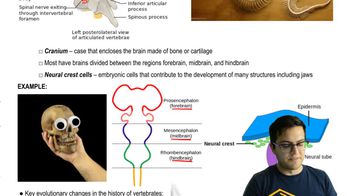
Chordates with a bony or cartilaginous skeleton, including a vertebrae and cranium.
What are the three regions of the vertebrate brain?
Forebrain, midbrain, and hindbrain.
Gnathostomes
Jawed vertebrates, including fish, amphibians, reptiles, and mammals.
What is the significance of jaws in vertebrate evolution?
Jaws allowed for more efficient feeding and are a major evolutionary milestone.
Bony endoskeleton
An internal skeleton made mostly of bone, providing support and protection.
What are ray-finned fish?
Bony fish with fins supported by parallel bones and webs of skin, the most diverse group of vertebrates.
Lobe-finned fish
Fish with muscular fins that are precursors to the limbs of tetrapods.
Tetrapods
Four-limbed vertebrates that include amphibians, reptiles, and mammals.
What is a swim bladder?
A gas-filled sac in bony fish that helps maintain buoyancy.
Operculum
Bony flaps that protect the gills in bony fish.
Amphibians
Ectothermic tetrapods that live both in water and on land, including salamanders, frogs, and apodens.
What is the function of the closed circulatory system in tetrapods?
Delivers sufficient oxygen to limb muscles for life on land.
Amniotic egg
An egg with specialized membranes that protect the embryo, seen in reptiles and some mammals.
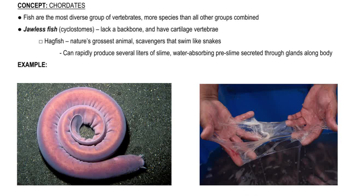
What are cyclostomes?
Jawless fish like hagfish and lampreys, characterized by a circular mouth.
Hagfish
Jawless fish that secrete slime for defense and have a cartilage skeleton.
Lampreys
Parasitic jawless fish with a circular mouth filled with teeth, and a cartilage skeleton not made from collagen.
Chondrichthyans
Cartilaginous fish like sharks, rays, and skates, with a skeleton made of cartilage.
What is the lateral line system?
A sensory system in fish that detects movements and vibrations in the water.
What are the three types of reproduction in sharks?
Oviparous (egg-laying), ovoviviparous (eggs hatch inside the mother), and viviparous (live birth).
What is the significance of the coelacanth?
A lobe-finned fish once thought extinct, providing insight into the evolution of tetrapods.
What does ectothermic mean?
Organisms that rely on external sources for body heat.
 BackBack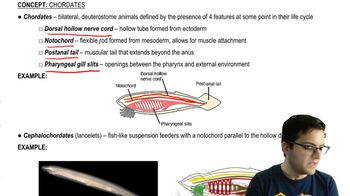
 05:34
05:34