Pearson+ LogoPearson+ Logo
Ch. 13 - Understanding Race
Belk, Maier - Biology: Science for Life 6th Edition
Belk, Maier6th EditionBiology: Science for LifeISBN: 9780135214084Not the one you use?Change textbook
Chapter 13, Problem 1

Define 'biological species.'

Verified step by step guidance
1
Understand that the concept of 'biological species' is part of the Biological Species Concept, which is widely used in biology to define species.
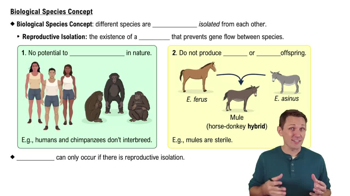
Learn that a biological species is defined as a group of organisms that can interbreed and produce viable, fertile offspring under natural conditions.
Recognize that members of a biological species are reproductively isolated from members of other species, meaning they cannot successfully interbreed with organisms outside their species.
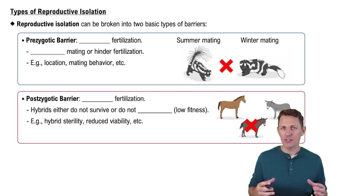
Note that reproductive isolation can occur due to prezygotic barriers (e.g., differences in mating behaviors or physical incompatibilities) or postzygotic barriers (e.g., hybrid sterility or inviability).
Understand that while the Biological Species Concept is useful, it has limitations, such as difficulty applying it to asexual organisms or extinct species, where reproductive isolation cannot be directly observed.

Verified video answer for a similar problem:

This video solution was recommended by our tutors as helpful for the problem above.
Video duration:
2m
Was this helpful?

Key Concepts

Here are the essential concepts you must grasp in order to answer the question correctly.

Biological Species Concept

The Biological Species Concept defines a species as a group of organisms that can interbreed and produce fertile offspring in natural conditions. This concept emphasizes reproductive isolation, meaning that members of different species do not typically mate or produce viable offspring, thus maintaining distinct genetic identities.
Recommended video:
03:24
Biological Species Concept

Reproductive Isolation

Reproductive isolation is a key mechanism that prevents species from interbreeding. It can occur through various barriers, including temporal isolation (different mating seasons), behavioral isolation (different mating rituals), and mechanical isolation (incompatible reproductive structures), ensuring that species remain genetically distinct.
Recommended video:
02:47
Types of Reproductive Isolation

Speciation

Speciation is the evolutionary process through which new biological species arise. It often occurs when populations of a species become isolated from each other, leading to genetic divergence over time due to natural selection, genetic drift, or mutation, ultimately resulting in the formation of distinct species.
Recommended video:
Guided course
02:53
Allopatric Speciation