Pearson+ LogoPearson+ Logo
Ch. 30 How Animals Move
Taylor - Campbell Biology: Concepts & Connections 10th Edition
Taylor, Simon, Dickey, Hogan10th EditionCampbell Biology: Concepts & ConnectionsISBN: 9780136538783Not the one you use?Change textbook
Chapter 30, Problem 1

Complete this concept map on animal movement.
Concept map illustrating animal movement, including skeleton types and muscle contraction.

Verified step by step guidance
1
Step 1: Animal movement requires both muscles and a skeleton. Fill in (a) with 'muscles' and (b) with 'skeleton'.
Step 2: The types of skeletons include hydrostatic skeletons, exoskeletons, and endoskeletons. Fill in (c) with 'exoskeleton'.
Step 3: Units of contraction in muscles are sarcomeres. Fill in (d) with 'sarcomeres'.
Step 4: Endoskeletons are made of bone and cartilage. Fill in (e) with 'bone and cartilage'.
Step 5: The sliding-filament model explains how myosin pulls actin filaments to shorten sarcomeres, enabling muscle contraction.

Verified video answer for a similar problem:

This video solution was recommended by our tutors as helpful for the problem above.
Video duration:
55s
Was this helpful?

Key Concepts

Here are the essential concepts you must grasp in order to answer the question correctly.

Types of Skeletons

Animals utilize different types of skeletons to facilitate movement, primarily categorized into three types: hydrostatic skeletons, exoskeletons, and endoskeletons. Hydrostatic skeletons, found in organisms like jellyfish, rely on fluid pressure, while exoskeletons, such as those in insects, provide external support. Endoskeletons, like those in vertebrates, are internal structures that support the body and allow for greater mobility.
Recommended video:
Guided course
02:08
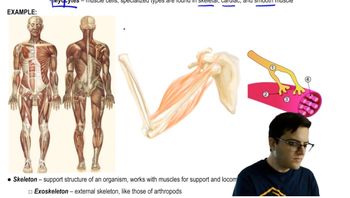
Muscle System and Skeleton

Antagonistic Muscle Pairs

Movement in animals is often achieved through the action of antagonistic muscle pairs, where one muscle contracts while the other relaxes. This coordinated action allows for precise control of movement, such as bending and straightening limbs. For example, in the human arm, the biceps and triceps work as antagonistic pairs to enable flexion and extension.
Recommended video:
Guided course
02:08
Muscle System and Skeleton

Sliding-Filament Model

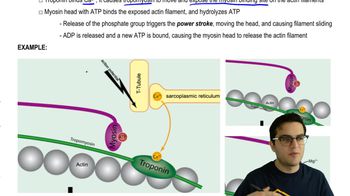
The sliding-filament model explains how muscles contract at the molecular level. According to this model, muscle fibers shorten as myosin filaments pull on actin filaments, causing the muscle to contract. This process is fundamental to muscle function and is essential for all types of animal movement, from walking to flying.
Recommended video:
Guided course
04:30
Sliding Filament Model