Skip to main content
Anatomy & Physiology
My Course
Learn
Exam Prep
AI Tutor
Study Guides
Textbook Solutions
Flashcards
Explore
My Course
Learn
Exam Prep
AI Tutor
Study Guides
Textbook Solutions
Flashcards
Explore
Back
The Skull definitions
2 students found this helpful
You can tap to flip the card.
Define:
Cranial Bones
You can tap to
flip the card.
👆
Cranial Bones
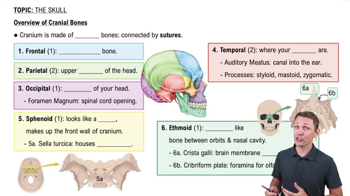
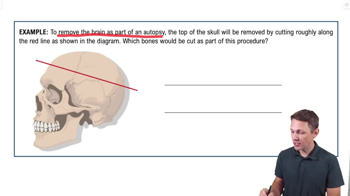
Bones forming the protective structure around the brain, including frontal, parietal, occipital, temporal, sphenoid, and ethmoid.
Track progress
Control buttons has been changed to "navigation" mode.
1/15
Related flashcards
Related practice
Recommended videos
Guided course
4:42
Introduction to the Skull
Bruce Bryan
15263
views
336
rank
Guided course
8:20
Overview of Cranial Bones
Bruce Bryan
11973
views
346
rank
Guided course
2:12
The Skull Example 1
Bruce Bryan
8117
views
195
rank
Terms in this set (15)
Hide definitions
Cranial Bones
Bones forming the protective structure around the brain, including frontal, parietal, occipital, temporal, sphenoid, and ethmoid.
Facial Bones
Fourteen bones structuring the face, including maxilla, mandible, zygomatic, nasal, lacrimal, inferior nasal conchae, vomer, and palatine.
Frontal Bone
Bone forming the forehead and part of the eye sockets, contributing to the cranial structure.
Parietal Bones
Paired bones forming the upper sides and roof of the cranial cavity.
Occipital Bone
Bone forming the back and base of the skull, containing the foramen magnum for spinal cord passage.
Temporal Bones
Bones on the sides of the skull, housing structures for hearing and balance.
Sphenoid Bone
Bat-shaped bone at the skull base, housing the pituitary gland in the sella turcica.
Ethmoid Bone
Sieve-like bone between the eyes, contributing to the nasal cavity and septum.
Maxilla
Upper jawbone forming part of the nasal cavity and eye sockets, holding upper teeth.
Mandible
Lower jawbone, the only movable skull bone, holding lower teeth.
Zygomatic Bones
Cheekbones forming part of the eye socket's lateral wall.
Nasal Bones
Small bones forming the bridge of the nose.
Lacrimal Bones
Small bones forming part of the inner eye socket, associated with tear production.
Inferior Nasal Conchae
Curved bones in the nasal cavity increasing surface area for air filtration.
Sinuses
Air-filled cavities in bones like frontal, ethmoid, maxillary, and sphenoid, aiding in skull lightening and vocal resonance.
 BackBack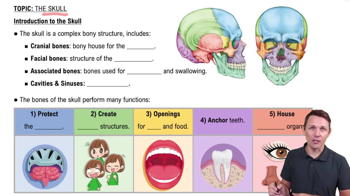
 4:42
4:42