Skip to main content
Anatomy & Physiology
My Course
Learn
Exam Prep
AI Tutor
Study Guides
Textbook Solutions
Flashcards
Explore
My Course
Learn
Exam Prep
AI Tutor
Study Guides
Textbook Solutions
Flashcards
Explore
Back
Placentation definitions
You can tap to flip the card.
Placenta
You can tap to
flip the card.
👆
Placenta
A temporary organ formed from maternal and fetal tissues, facilitating exchange of oxygen, nutrients, and waste between mother and conceptus.
Track progress
Control buttons has been changed to "navigation" mode.
1/15
Related flashcards
Recommended videos
Guided course
2:19
The Placenta
Bruce Bryan
861
views
10
rank
Guided course
1:12
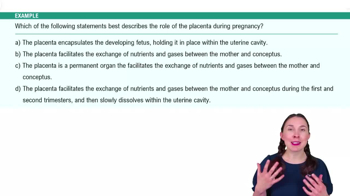
Placentation Example 1
Bruce Bryan
858
views
10
rank
Guided course
3:22
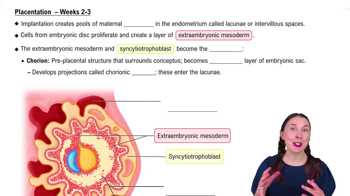
Placentation – Weeks 2-3
Bruce Bryan
847
views
8
rank
Terms in this set (15)
Hide definitions
Placenta
A temporary organ formed from maternal and fetal tissues, facilitating exchange of oxygen, nutrients, and waste between mother and conceptus.
HCG
A hormone produced by the placenta starting around days 10-12 post-conception, detectable by modern pregnancy tests.
Estrogen
A hormone produced by the placenta, with levels fluctuating throughout pregnancy, supporting gestational processes.
Progesterone
A hormone produced by the placenta, crucial for maintaining pregnancy and supporting fetal development.
Placental lactogen
A hormone produced by the placenta, involved in regulating maternal metabolism and fetal growth.
Relaxin
A hormone produced by the placenta, aiding in the relaxation of pelvic ligaments and cervix during pregnancy.
Placentation
The process of forming the placenta, beginning during implantation and continuing throughout the fetal period.
Syncytiotrophoblast
A tissue that releases enzymes to erode the endometrium, forming pools of maternal blood known as lacunae.
Lacunae
Pools of maternal blood within the endometrium, formed during early placentation for nutrient exchange.
Extraembryonic mesoderm
A layer of cells forming around the embryo, contributing to the development of the chorion.
Chorion
A structure formed from extraembryonic mesoderm and syncytiotrophoblast, developing into the outer layer of the embryonic sac.
Chorionic villi
Projections from the chorion that enter lacunae, serving as the main site of exchange between mother and conceptus.
Umbilical arteries
Blood vessels that connect the chorionic villi to the fetal circulatory system, facilitating nutrient and gas exchange.
Umbilical vein
A blood vessel that carries oxygenated blood from the placenta to the fetus, part of the umbilical cord.
Endometrium
The uterine lining that undergoes changes to support placentation, contributing to the maternal portion of the placenta.
 Back
Back
 Back
Back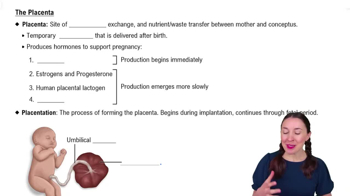
 2:19
2:19