Skip to main content
Anatomy & Physiology
My Course
Learn
Exam Prep
AI Tutor
Study Guides
Textbook Solutions
Flashcards
Explore
Try the app
My Course
Learn
Exam Prep
AI Tutor
Study Guides
Textbook Solutions
Flashcards
Explore
Try the app
Back
Introduction to the Reproductive System definitions
5 students found this helpful
You can tap to flip the card.
Gonads
You can tap to flip the card.
👆
Gonads
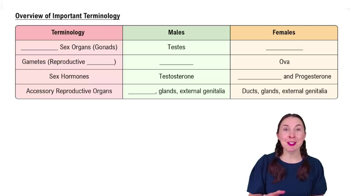
Primary sex organs responsible for producing sex hormones and gametes, including testes in males and ovaries in females.
Track progress
Control buttons has been changed to "navigation" mode.
1/15
Related flashcards
Recommended videos
Introduction to the Reproductive System quiz #1
Introduction to the Reproductive System
39 Terms
Introduction to the Reproductive System quiz #2
Introduction to the Reproductive System
37 Terms
Introduction to the Reproductive System quiz #3
Introduction to the Reproductive System
37 Terms
2:08
What is the Reproductive System?
3732
views
66
rank
2:03
Overview of Important Terminology
4032
views
79
rank
0:56
Introduction to the Reproductive System Example 1
3559
views
52
rank
Terms in this set (15)
Hide definitions
Gonads
Primary sex organs responsible for producing sex hormones and gametes, including testes in males and ovaries in females.
Testes
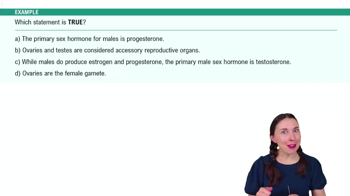
Male gonads that produce sperm and testosterone, playing a key role in male reproductive function.
Ovaries
Female gonads that produce ova, estrogen, and progesterone, essential for female reproductive health.
Gametes
Reproductive cells, with sperm in males and ova in females, crucial for sexual reproduction.
Sperm
Male gametes produced in the testes, essential for fertilization of the female ova.
Ova
Female gametes produced in the ovaries, capable of being fertilized by sperm.
Testosterone
Primary male sex hormone, crucial for male reproductive organ function and secondary sexual characteristics.
Estrogen
Primary female sex hormone, important for female reproductive organ function and secondary sexual characteristics.
Progesterone
Female sex hormone involved in the menstrual cycle and pregnancy, produced in the ovaries.
Accessory reproductive organs
Structures like ducts, glands, and external genitalia that support reproductive functions in both sexes.
Meiosis
Cell division process that produces gametes with half the genetic material, essential for sexual reproduction.
Copulation
Penile-vaginal intercourse, facilitating the union of male and female gametes for reproduction.
Fertilization
Process of combining genetic material from sperm and ova, leading to the formation of a zygote.
Puberty
Developmental stage marking the activation and maturation of the reproductive system and secondary sexual characteristics.
Lactation
Production of milk by mammary glands, supporting infant survival post-birth.
 BackBack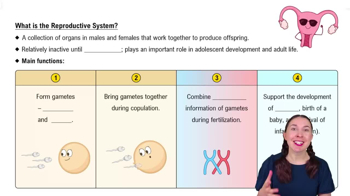
 2:08
2:08