Skip to main content
Anatomy & Physiology
My Course
Learn
Exam Prep
AI Tutor
Study Guides
Textbook Solutions
Flashcards
Explore
Try the app
My Course
Learn
Exam Prep
AI Tutor
Study Guides
Textbook Solutions
Flashcards
Explore
Try the app
Back
Introduction to the Endocrine System definitions
5 students found this helpful
You can tap to flip the card.
Endocrine System
You can tap to flip the card.
👆
Endocrine System
A network of glands that release hormones into the bloodstream for whole-body signaling.
Track progress
Control buttons has been changed to "navigation" mode.
1/15
Related flashcards
Related practice
Recommended videos
Introduction to the Endocrine System quiz #1
Introduction to the Endocrine System
39 Terms
Introduction to the Endocrine System quiz #2
Introduction to the Endocrine System
38 Terms
Introduction to the Endocrine System quiz #3
Introduction to the Endocrine System
40 Terms
Introduction to the Endocrine System
16. The Endocrine System
7 problems
Topic
Jason
Membrane Bound Receptors and Secondary Messengers
16. The Endocrine System
3 problems
Topic
16. The Endocrine System
5 topics
9 problems
Chapter
Bruce
Guided course
7:06
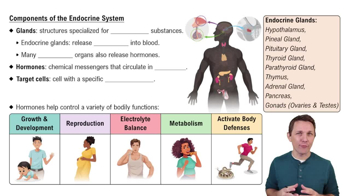
Components of the Endocrine System
11816
views
356
rank
Guided course
6:20
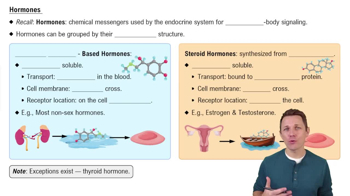
Hormones
9032
views
221
rank
Guided course
3:33
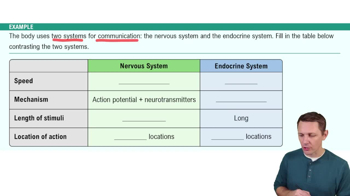
Introduction to the Endocrine System Example 1
13071
views
364
rank
1
comments
Terms in this set (15)
Hide definitions
Endocrine System
A network of glands that release hormones into the bloodstream for whole-body signaling.
Hormone
Chemical messengers released by glands, traveling through blood to target cells with specific receptors.
Endocrine Gland
Structures specialized for secreting hormones directly into the bloodstream.
Receptor
A protein on or in a cell that binds to a specific hormone to initiate a response.
Autocrine Signaling
A form of signaling where a cell releases a chemical messenger that binds to receptors on its own surface.
Paracrine Signaling
A form of signaling where cells release messengers that affect nearby cells within the same tissue.
Amino Acid-Based Hormones
Water-soluble hormones that bind to receptors on the cell membrane and include epinephrine.
Steroid Hormones
Lipid-soluble hormones derived from cholesterol, traveling bound to proteins, and binding receptors inside cells.
Hypothalamus
A brain region that regulates homeostasis and links the nervous and endocrine systems.
Pituitary Gland
A gland under the hypothalamus that produces hormones influencing other endocrine glands.
Thyroid Gland
A gland regulating metabolism, located in the neck, producing thyroid hormones.
Adrenal Glands
Glands atop the kidneys that produce hormones like adrenaline, involved in stress response.
Pancreas
An organ with both digestive and endocrine functions, releasing hormones like insulin.
Gonads
Reproductive organs (ovaries and testes) that produce sex hormones like estrogen and testosterone.
Thyroid Hormone
An amino acid-based hormone that is hydrophobic, requiring a transport protein and intracellular receptors.
 BackBack

 7:06
7:06