Skip to main content
Anatomy & Physiology
My Course
Learn
Exam Prep
AI Tutor
Study Guides
Textbook Solutions
Flashcards
Explore
Try the app
My Course
Learn
Exam Prep
AI Tutor
Study Guides
Textbook Solutions
Flashcards
Explore
Try the app
Back
Introduction to First-Line Defenses definitions
1 student found this helpful
You can tap to flip the card.
Innate Immunity
You can tap to flip the card.
👆
Innate Immunity
A non-specific defense mechanism that acts as the body's first line of defense against pathogens.
Track progress
Control buttons has been changed to "navigation" mode.
1/10
Related flashcards
Recommended videos
Introduction to First-Line Defenses quiz
Introduction to First-Line Defenses
17 Terms
Introduction to First-Line Defenses quiz #1
Introduction to First-Line Defenses
10 Terms
1:56
First-Line Defenses
2615
views
42
rank
1:37
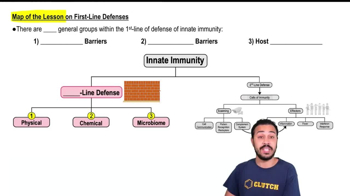
Map of the Lesson on First-Line Defenses
2350
views
44
rank
Terms in this set (10)
Hide definitions
Innate Immunity
A non-specific defense mechanism that acts as the body's first line of defense against pathogens.
First Line Defenses
Barriers that prevent microbes from entering the body, including physical, chemical, and microbiome components.
Physical Barriers
Structures like skin and mucus membranes that act as security walls against microbial entry.
Chemical Barriers
Substances produced by the body, such as antimicrobial peptides, that inhibit microbial growth.
Microbiome
The community of normal microbiota that resides on and within the body, contributing to innate immunity.
Skin
An external physical barrier that protects the body from microbial invasion.
Mucus Membranes
Internal linings that trap and expel pathogens, serving as a physical barrier.
Earwax
A substance found in the ear canal that acts as an internal barrier to trap and prevent microbial entry.
Antimicrobial Peptides
Small proteins produced by the body that destroy or inhibit the growth of microbes.
Bodily Fluids
Liquids produced by the body that can contain antimicrobial properties to protect against pathogens.
 BackBack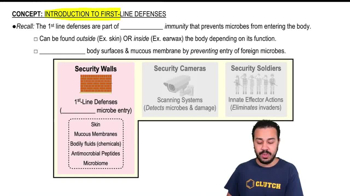
 1:56
1:56