Skip to main content
Anatomy & Physiology
My Course
Learn
Exam Prep
AI Tutor
Study Guides
Textbook Solutions
Flashcards
Explore
My Course
Learn
Exam Prep
AI Tutor
Study Guides
Textbook Solutions
Flashcards
Explore
Back
Directional Terms: Body Sides definitions
You can tap to flip the card.
Define:
Bilateral symmetry
You can tap to
flip the card.
👆
Bilateral symmetry
The condition where the right and left sides of the body are mirror images, separated by a midline.
Track progress
Control buttons has been changed to "navigation" mode.
1/15
Related flashcards
Related practice
Recommended videos
Directional Terms: Body Sides quiz
Directional Terms: Body Sides
10 Terms
Directional Terms: Body Sides quiz #1
Directional Terms: Body Sides
19 Terms
1. Introduction to Anatomy & Physiology - Part 1 of 3
9 topics
11 problems
Chapter
Bruce
1. Introduction to Anatomy & Physiology - Part 2 of 3
9 topics
10 problems
Chapter
1. Introduction to Anatomy & Physiology - Part 3 of 3
10 topics
8 problems
Chapter
Jason
Guided course
03:59
Medial and Lateral
Bruce Bryan
10150
views
188
rank
Guided course
02:24
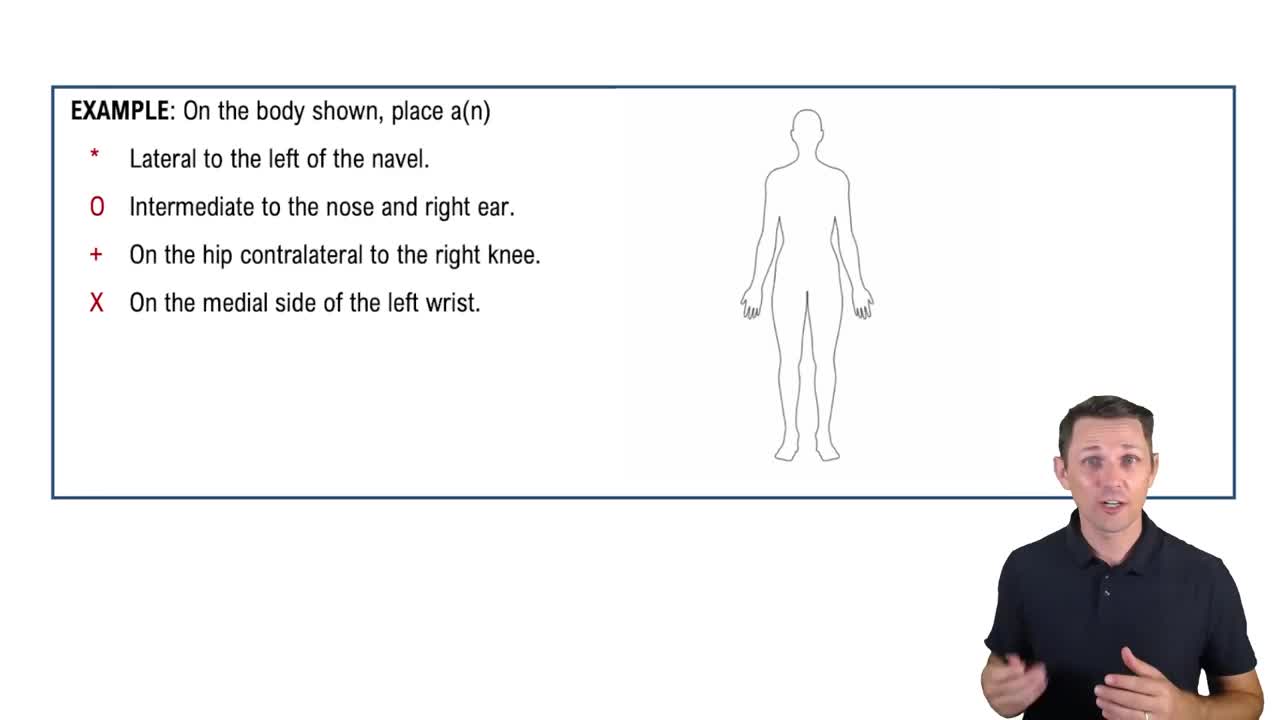
Directional Terms: Body Sides Example 1
Bruce Bryan
6451
views
147
rank
1
comments
Terms in this set (15)
Hide definitions
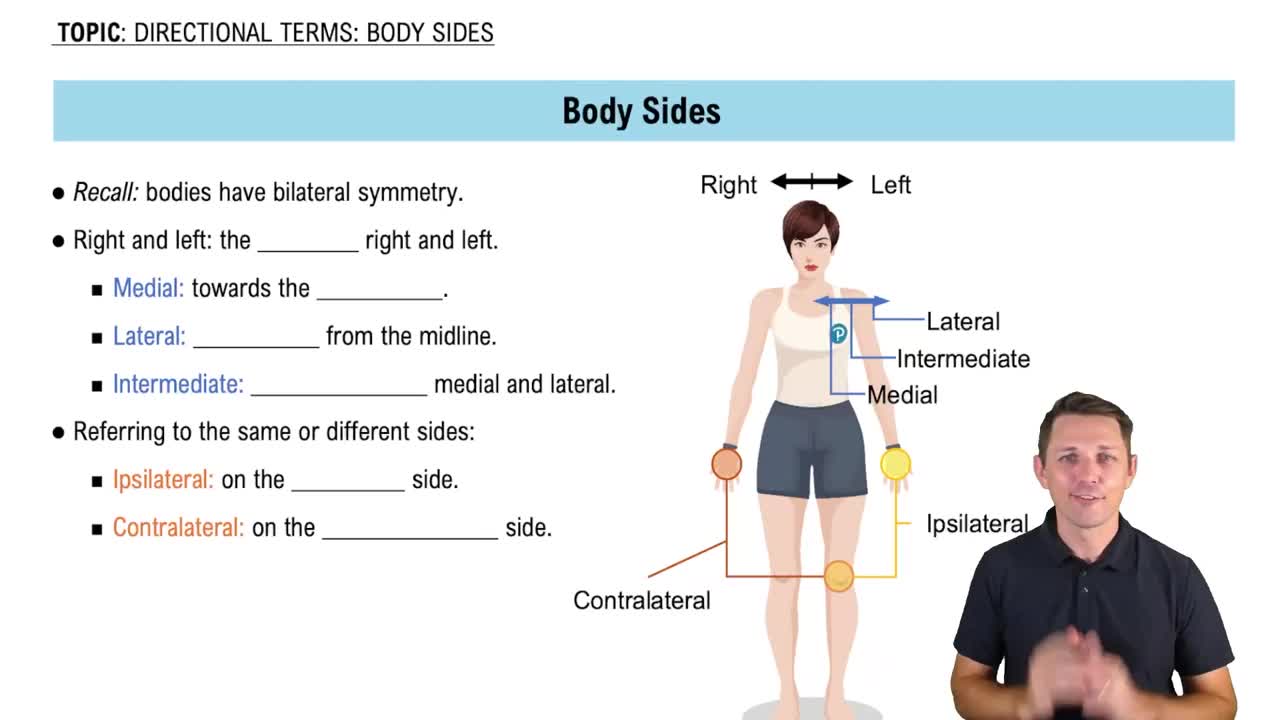
Bilateral symmetry
The condition where the right and left sides of the body are mirror images, separated by a midline.
Midline
An imaginary line that divides the body into right and left halves.
Medial
Positioned towards or closer to the midline of the body.
Lateral
Positioned away from or farther from the midline of the body.
Intermediate
Located between two structures on the medial-lateral axis.
Ipsilateral
Refers to structures on the same side of the body.
Contralateral
Refers to structures on opposite sides of the body.
Navel
Commonly known as the belly button, located on the midline of the abdomen.
Collarbone
A bone that is intermediate to the shoulder and the sternum.
Sternum
The breastbone located in the center of the chest.
Hip
A lateral structure relative to the navel.
Eye
A structure that can be medial to the ear and intermediate to the ear and nose.
Ear
A lateral structure relative to the eye.
Nose
A medial structure relative to the eye.
Left knee
An example of a structure that can be ipsilateral to the left hand and contralateral to the right hand.
 BackBack

 03:59
03:59