Skip to main content
Anatomy & Physiology
My Course
Learn
Exam Prep
AI Tutor
Study Guides
Textbook Solutions
Flashcards
Explore
My Course
Learn
Exam Prep
AI Tutor
Study Guides
Textbook Solutions
Flashcards
Explore
Back
Covalent Bonds definitions
1 student found this helpful
You can tap to flip the card.
Define:
Covalent Bond
You can tap to
flip the card.
👆
Covalent Bond
An interaction between two atoms resulting from the sharing of electrons.
Track progress
Control buttons has been changed to "navigation" mode.
1/15
Related practice
Recommended videos
Guided course
04:28
Covalent Bonds
Bruce Bryan
21218
views
372
rank
1
comments
Guided course
05:58
Nonpolar Covalent Bonds
Bruce Bryan
17295
views
302
rank
Guided course
06:59
Polar Covalent Bonds
Bruce Bryan
16337
views
268
rank
1
comments
Terms in this set (15)
Hide definitions
Covalent Bond
An interaction between two atoms resulting from the sharing of electrons.
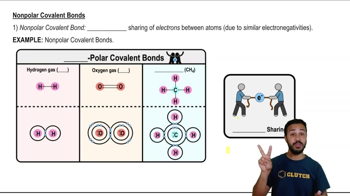
Nonpolar Covalent Bond
Characterized by equal sharing of electrons between atoms with similar electronegativities.
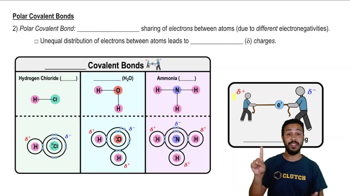
Polar Covalent Bond
Characterized by unequal sharing of electrons due to differences in electronegativity.
Electronegativity
A measure of an atom's ability to attract electrons, ranging from 0 to 4.
Periodic Table
Arrangement of elements reflecting trends in electronegativity, increasing from left to right and bottom to top.
Partial Charge
A charge resulting from unequal distribution of electrons in polar covalent bonds.
Hydrogen Chloride
A molecule with a polar covalent bond due to significant electronegativity difference between hydrogen and chlorine.
Water Molecule
Composed of two hydrogen atoms and one oxygen atom, exhibiting polar covalent bonds.
Ammonia
A molecule with one nitrogen and three hydrogen atoms, showing polar covalent bonds.
Methane
A molecule with one carbon and four hydrogen atoms, exhibiting nonpolar covalent bonds.
Oxygen Gas
Composed of two oxygen atoms sharing electrons equally, forming nonpolar covalent bonds.
Hydrogen Gas
Consists of two hydrogen atoms sharing electrons equally, forming nonpolar covalent bonds.
Fluorine
The most electronegative element, pulling electrons very strongly.
Delta Symbol
Greek symbol used to denote partial charges in polar covalent bonds.
Electron Distribution
Refers to how electrons are shared or distributed between atoms in a bond.
 BackBack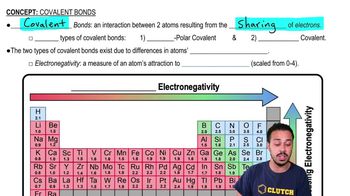
 04:28
04:28