Skip to main content
Anatomy & Physiology
My Course
Learn
Exam Prep
AI Tutor
Study Guides
Textbook Solutions
Flashcards
Explore
Try the app
My Course
Learn
Exam Prep
AI Tutor
Study Guides
Textbook Solutions
Flashcards
Explore
Try the app
Back
Cellular Respiration: Pyruvate Oxidation definitions
You can tap to flip the card.
Pyruvate
You can tap to flip the card.
👆
Pyruvate
A three-carbon molecule produced from glucose during glycolysis, transported to the mitochondrial matrix for oxidation.
Track progress
Control buttons has been changed to "navigation" mode.
1/10
Related flashcards
Recommended videos
Cellular Respiration: Pyruvate Oxidation quiz
Cellular Respiration: Pyruvate Oxidation
10 Terms
04:38
Pyruvate Oxidation
21119
views
318
rank
Terms in this set (10)
Hide definitions
Pyruvate
A three-carbon molecule produced from glucose during glycolysis, transported to the mitochondrial matrix for oxidation.
Mitochondrial Matrix
The innermost compartment of mitochondria where pyruvate oxidation occurs, converting pyruvate into Acetyl CoA.
Acetyl CoA
A molecule formed from pyruvate during oxidation, which enters the Krebs cycle in cellular respiration.
NADH
An electron carrier molecule produced during pyruvate oxidation when NAD+ gains electrons.
CO2
A byproduct of pyruvate oxidation, formed when a carbon atom is removed from pyruvate.
Cellular Respiration
A multi-step process including glycolysis, pyruvate oxidation, and the Krebs cycle, converting glucose into energy.
Glycolysis
The first stage of cellular respiration, breaking down glucose into two pyruvate molecules.
Electrons
Subatomic particles lost by pyruvate during oxidation, transferred to NAD+ to form NADH.
Krebs Cycle
The third stage of cellular respiration, following pyruvate oxidation, where Acetyl CoA is further processed.
Aerobic
A type of respiration requiring oxygen, encompassing glycolysis, pyruvate oxidation, and the Krebs cycle.
 BackBack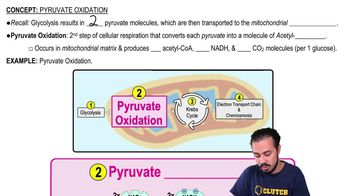
 04:38
04:38