Anatomy & Physiology
My Course
Learn
Exam Prep
AI Tutor
Study Guides
Textbook Solutions
Flashcards
Explore
My Course
Learn
Exam Prep
AI Tutor
Study Guides
Textbook Solutions
Flashcards
Explore
Back
ATP definitions
1 student found this helpful
You can tap to flip the card.
Define:
Adenosine Triphosphate
You can tap to
flip the card.
👆
Adenosine Triphosphate
A high-energy molecule used to power cellular activities, consisting of adenosine and three phosphate groups.
Track progress
Control buttons has been changed to "navigation" mode.
1/15
Related flashcards
Related practice
Recommended videos
Guided course
06:44
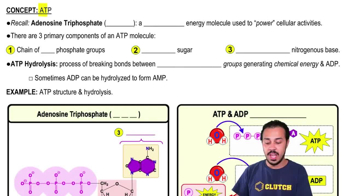
ATP
Bruce Bryan
19222
views
282
rank
Guided course
04:57
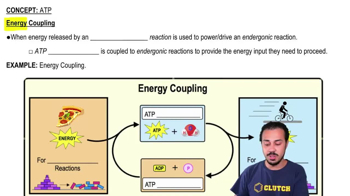
Energy Coupling
Bruce Bryan
14777
views
179
rank
Guided course
03:00
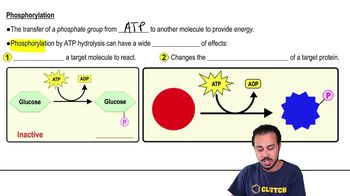
Phosphorylation
Bruce Bryan
13350
views
272
rank
Terms in this set (15)
Hide definitions
Adenosine Triphosphate
A high-energy molecule used to power cellular activities, consisting of adenosine and three phosphate groups.
Phosphate Groups
Three linked groups in ATP, whose bonds release energy when broken during hydrolysis.
Adenosine
A component of ATP made up of an adenine nitrogenous base and a pentose sugar.
Pentose Sugar
A five-carbon sugar that, along with adenine, forms the adenosine part of ATP.
Adenine
A nitrogenous base that pairs with a pentose sugar to form adenosine in ATP.
ATP Hydrolysis
The process of breaking bonds between phosphate groups in ATP, releasing energy.
Adenosine Diphosphate
A molecule formed from ATP hydrolysis, containing two phosphate groups.
Adenosine Monophosphate
A molecule formed from further hydrolysis of ADP, containing one phosphate group.
Energy Coupling
Using energy from exergonic reactions, like ATP hydrolysis, to drive endergonic reactions.
Exergonic Reaction
A reaction that releases energy, such as ATP hydrolysis.
Endergonic Reaction
A reaction that requires energy input, often driven by ATP hydrolysis.
Phosphorylation
The transfer of a phosphate group from ATP to another molecule, altering its activity.
Activation
A process where phosphorylation makes a molecule reactive or changes its conformation.
Conformation
The shape or structure of a molecule, which can be altered by phosphorylation.
Kinetic Energy
Energy of motion, often derived from ATP hydrolysis in cellular activities.