
Textbook Question
Which of the following is greater?
(a) The osmotic pressure of the interstitial fluid during inflammation
(b) The osmotic pressure of the interstitial fluid during normal conditions
(c) Neither is greater
986
views

 Verified step by step guidance
 7:11
7:11
 6:52
6:52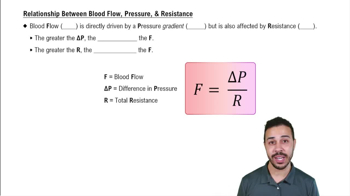 6:40
6:40Which of the following is greater?
(a) The osmotic pressure of the interstitial fluid during inflammation
(b) The osmotic pressure of the interstitial fluid during normal conditions
(c) Neither is greater
A major difference between the arterial and venous systems is that
(a) Arteries are usually more superficial than veins.
(b) In the limbs there is dual venous drainage.
(c) Veins are usually less branched compared to arteries.
(d) Veins exhibit a much more orderly pattern of branching in the limbs.
(e) Veins are not found in the abdominal cavity.
Which of the following conditions would have the greatest effect on peripheral resistance?
(a) Doubling the length of a vessel
(b) Doubling the diameter of a vessel
(c) Doubling the viscosity of the blood
(d) Doubling the turbulence of the blood
(e) Doubling the number of white cells in the blood
The vein that drains the dural sinuses of the brain is the
(a) Cephalic vein
(b) Great saphenous vein
(c) Internal jugular vein
(d) Superior vena cava
The vein that collects most of the venous blood inferior to the diaphragm is the
(a) Superior vena cava
(b) Great saphenous vein
(c) Inferior vena cava
(d) Azygos vein
What are the primary forces that cause fluid to move?
(a) Out of a capillary at its arterial end and into the interstitial fluid
(b) Into a capillary at its venous end from the interstitial fluid?