Ch. 19 Blood
Martini - Fundamentals of Anatomy & Physiology 11th Edition
Martini, Nath, Bartholomew11th EditionFundamentals of Anatomy & PhysiologyISBN: 9780136874089Not the one you use?Change textbook
Chapter 19, Problem 9

___ and ____ affect almost every aspect of the clotting process.
(a) Calcium, vitamin K
(b) Calcium, vitamin B12
(c) Sodium, vitamin K
(d) Sodium, vitamin B12

Verified step by step guidance
1
Step 1: Understand the role of calcium in the clotting process. Calcium ions (Ca^{2+}) are essential cofactors in multiple steps of the blood clotting cascade, helping activate various clotting factors.
Step 2: Recognize the importance of vitamin K in clotting. Vitamin K is crucial for the synthesis of several clotting factors (such as prothrombin) in the liver, which are necessary for proper blood coagulation.
Step 3: Review the options given and identify which substances are known to influence clotting. Calcium and vitamin K are both well-established as key players in clotting, whereas sodium and vitamins B12 do not have direct roles in this process.
Step 4: Conclude that the correct pair affecting almost every aspect of the clotting process is calcium and vitamin K.
Step 5: Confirm that the answer corresponds to option (a) Calcium, vitamin K.

Verified video answer for a similar problem:

This video solution was recommended by our tutors as helpful for the problem above.
Was this helpful?

Key Concepts

Here are the essential concepts you must grasp in order to answer the question correctly.

Calcium's Role in Clotting

Calcium ions are essential for various steps in the blood clotting cascade, including activation of clotting factors and stabilization of the clot. Without adequate calcium, the clotting process is impaired, leading to bleeding disorders.
Recommended video:
10:05
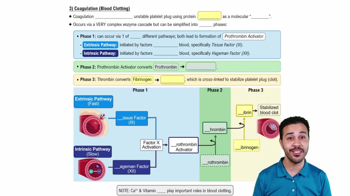
Coagulation (Blood Clotting)

Vitamin K and Clotting Factors

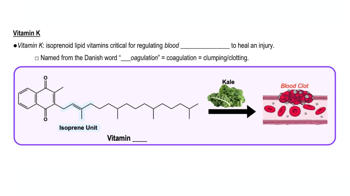
Vitamin K is crucial for the synthesis of several clotting factors (II, VII, IX, and X) in the liver. It acts as a coenzyme for the carboxylation of glutamic acid residues, enabling these factors to bind calcium and function properly in coagulation.
Recommended video:
01:38
Vitamin K

Blood Clotting Cascade

The blood clotting cascade is a complex series of enzymatic reactions that lead to the formation of a fibrin clot. It involves intrinsic and extrinsic pathways that converge to activate thrombin, which then converts fibrinogen to fibrin, stabilizing the clot.
Recommended video:
10:05
Coagulation (Blood Clotting)