Ch. 7 The Nervous System
Marieb - Essentials of Human Anatomy & Physiology 13th Edition
Marieb13th EditionEssentials of Human Anatomy & PhysiologyISBN: 9780135624340Not the one you use?Change textbook
Chapter 7, Problem 6b

Choose the proper term to respond to the statements describing various brain areas.
a. Cerebellum
b. Corpora quadrigemina
c. Corpus callosum
d. Hypothalamus
e. Medulla
f. Midbrain
g. Pons
h. Thalamus
2. Control of temperature, autonomic nervous system reflexes, hunger, and water balance

Verified step by step guidance
1
Step 1: Begin by analyzing the functions described in the problem: control of temperature, autonomic nervous system reflexes, hunger, and water balance. These functions are primarily associated with maintaining homeostasis in the body.
Step 2: Recall the role of the hypothalamus in the brain. The hypothalamus is a key structure responsible for regulating body temperature, hunger, thirst, and autonomic nervous system functions. It plays a central role in maintaining homeostasis.
Step 3: Compare the functions listed in the problem with the roles of other brain areas provided in the options. For example, the cerebellum is involved in motor coordination, the corpus callosum connects the two hemispheres of the brain, and the thalamus acts as a relay station for sensory information. These do not match the functions described.
Step 4: Eliminate options that do not align with the functions described in the problem. For instance, the medulla controls vital functions like breathing and heart rate, while the pons and midbrain are involved in motor control and sensory processing. These are not directly related to temperature regulation, hunger, or water balance.
Step 5: Conclude that the hypothalamus is the correct term that matches the functions described in the problem. It is the brain area responsible for controlling temperature, autonomic nervous system reflexes, hunger, and water balance.

Verified video answer for a similar problem:

This video solution was recommended by our tutors as helpful for the problem above.
Video duration:
2m
Was this helpful?

Key Concepts

Here are the essential concepts you must grasp in order to answer the question correctly.

Hypothalamus

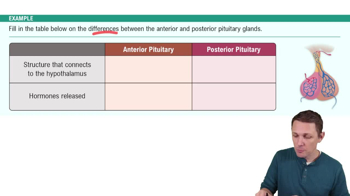
The hypothalamus is a small but crucial brain region located below the thalamus. It plays a vital role in maintaining homeostasis by regulating various autonomic functions, including temperature control, hunger, thirst, and circadian rhythms. The hypothalamus also influences the endocrine system by controlling the pituitary gland, thereby affecting hormone release and overall bodily functions.
Recommended video:
Guided course
6:11
The Hypothalamus and Pituitary Gland Example 3

Autonomic Nervous System

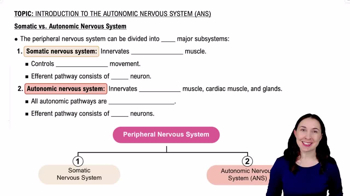
The autonomic nervous system (ANS) is a component of the peripheral nervous system that regulates involuntary physiological functions, such as heart rate, digestion, and respiratory rate. It is divided into the sympathetic and parasympathetic systems, which work together to maintain balance in the body’s internal environment. The ANS is closely linked to the hypothalamus, which helps coordinate its responses to maintain homeostasis.
Recommended video:
1:50
Somatic vs. Autonomic Nervous System

Homeostasis

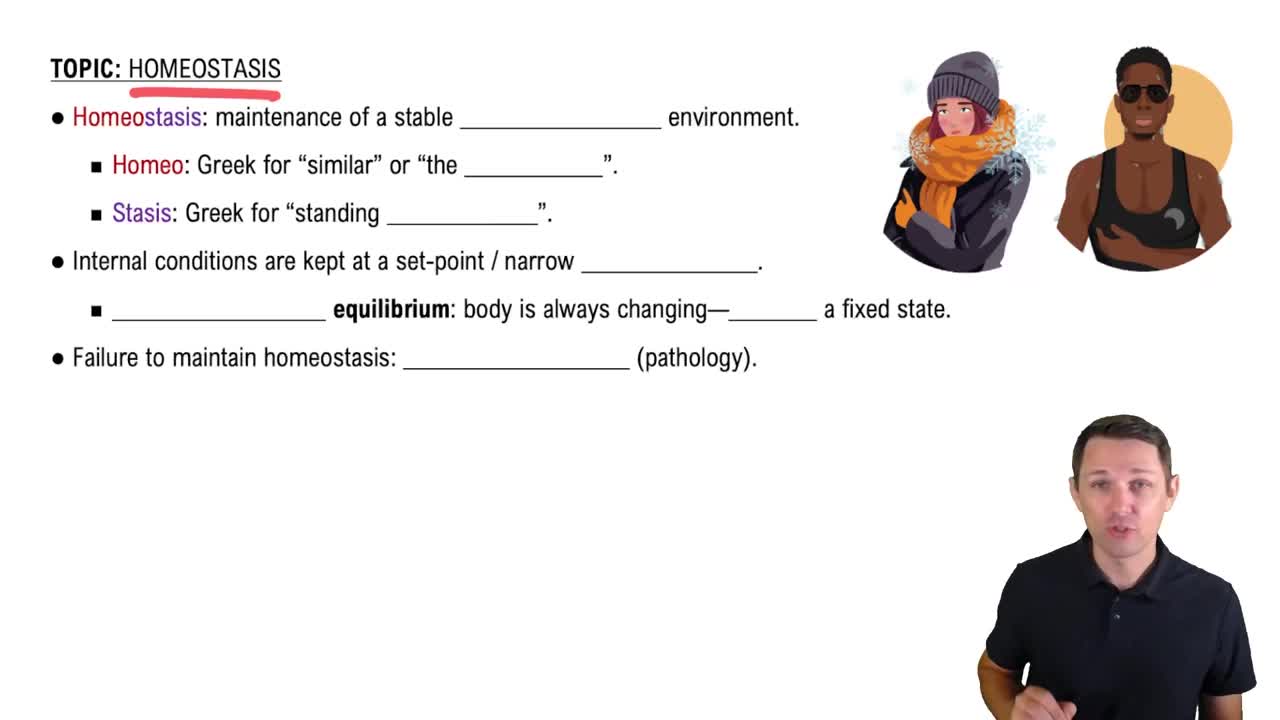
Homeostasis refers to the body's ability to maintain a stable internal environment despite external changes. This involves various physiological processes that regulate temperature, pH, hydration, and other critical factors. The hypothalamus plays a central role in homeostasis by integrating signals from the body and initiating appropriate responses, such as sweating to cool down or stimulating hunger when energy levels are low.
Recommended video:
Guided course
01:59
Introduction to Homeostasis
Related Practice
Textbook Question

Choose the proper term to respond to the statements describing various brain areas.

a. Cerebellum

b. Corpora quadrigemina

c. Corpus callosum

d. Hypothalamus

e. Medulla

f. Midbrain

g. Pons

h. Thalamus

4. Relay stations for visual and auditory stimuli input; found the mid-brain

720
views
Textbook Question

Choose the proper term to respond to the statements describing various brain areas.

a. Cerebellum

b. Corpora quadrigemina

c. Corpus callosum

d. Hypothalamus

e. Medulla

f. Midbrain

g. Pons

h. Thalamus

3. Houses the substantia nigra and cerebral aqueduct

671
views
Textbook Question

Choose the proper term to respond to the statements describing various brain areas.

a. Cerebellum

b. Corpora quadrigemina

c. Corpus callosum

d. Hypothalamus

e. Medulla

f. Midbrain

g. Pons

h. Thalamus

1. Region where there is a gross crossover of fibers of descending pyramidal tracts

686
views
Textbook Question

Choose the proper term to respond to the statements describing various brain areas.

a. Cerebellum

b. Corpora quadrigemina

c. Corpus callosum

d. Hypothalamus

e. Medulla

f. Midbrain

g. Pons

h. Thalamus

6. Brain area through which all the sensory input is relayed to get to the cerebral cortex

677
views
Textbook Question

Histological examination of a slice of neural tissue reveals a bundle of nerve fibers held together by cells whose multiple processes wrap around several fibers and form a myelin sheath. The specimen is likely to be:

a. A nucleus

b. A ganglion

c. A nerve

d. A tract

811
views
Textbook Question

The pineal gland is located in the:

a. Hypothalamus

b. Mesencephalon

c. Epithalamus

d. Corpus callosum

804
views