Ch. 16 The Autonomic Nervous System and Higher-Order Functions
Martini - Fundamentals of Anatomy & Physiology 11th Edition
Martini, Nath, Bartholomew11th EditionFundamentals of Anatomy & PhysiologyISBN: 9780136874089Not the one you use?Change textbook
Chapter 16, Problem 22

Why does sympathetic function remain intact even when the anterior roots of the cervical spinal nerves are damaged?

Verified step by step guidance
1
Understand the anatomy of spinal nerves: each spinal nerve is formed by the union of a dorsal (posterior) root and a ventral (anterior) root. The dorsal root carries sensory (afferent) fibers, while the ventral root carries motor (efferent) fibers.
Recognize that the anterior roots contain somatic motor fibers that innervate skeletal muscles, but sympathetic fibers have a different pathway.
Recall that sympathetic preganglionic neurons originate in the lateral horn of the spinal cord (specifically from T1 to L2 levels) and their axons exit the spinal cord via the ventral roots of these thoracolumbar segments, not the cervical segments.
Note that sympathetic postganglionic fibers reach the cervical region by traveling through sympathetic chain ganglia and then join spinal nerves via gray rami communicantes, which are branches of the sympathetic chain, not through the anterior roots of cervical spinal nerves.
Therefore, damage to the anterior roots of cervical spinal nerves does not disrupt the sympathetic pathways because sympathetic fibers reach the cervical region through the sympathetic chain and gray rami communicantes, bypassing the anterior roots of cervical spinal nerves.

Verified video answer for a similar problem:

This video solution was recommended by our tutors as helpful for the problem above.
Was this helpful?

Key Concepts

Here are the essential concepts you must grasp in order to answer the question correctly.

Structure of Spinal Nerves and Roots

Spinal nerves are formed by the merging of dorsal (sensory) and ventral (motor) roots. The anterior (ventral) roots carry motor fibers, while the posterior (dorsal) roots carry sensory fibers. Understanding this separation is essential to grasp how damage to one root affects specific functions.
Recommended video:
Guided course
2:25
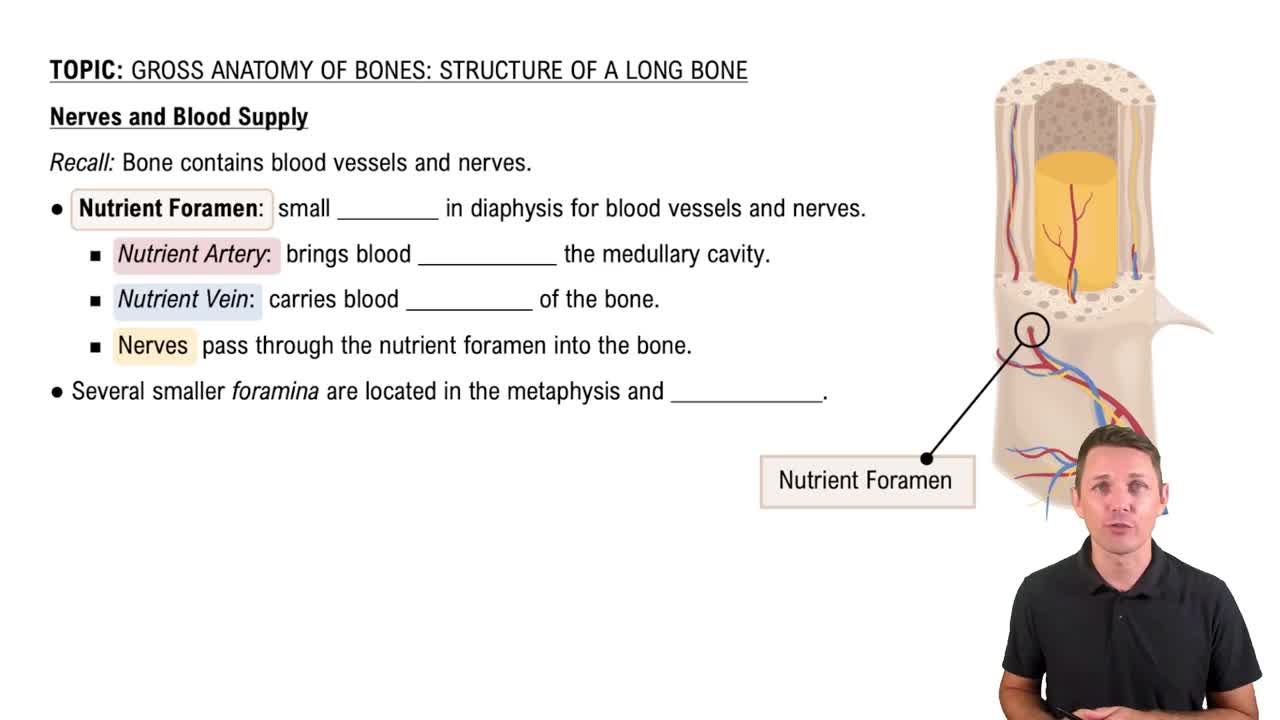
Nerves and Blood Supply

Sympathetic Nervous System Pathways

The sympathetic nervous system primarily originates from the thoracolumbar region (T1-L2) of the spinal cord, not the cervical region. Its preganglionic fibers exit through the anterior roots of thoracic and lumbar spinal nerves, which explains why cervical anterior root damage does not disrupt sympathetic function.
Recommended video:
1:21
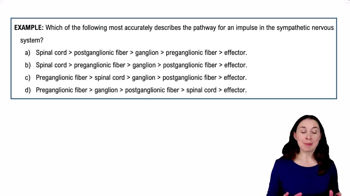
Sympathetic Nervous System Example 3

Role of Cervical Spinal Nerves in Sympathetic Function

Although cervical spinal nerves contribute to some sympathetic pathways via the cervical sympathetic ganglia, the main sympathetic output does not depend on cervical anterior roots. Therefore, damage to these roots does not abolish sympathetic function, as the sympathetic signals bypass or are maintained through other pathways.
Recommended video:
2:52
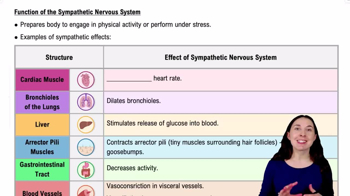
Function of the Sympathetic Nervous System
Related Practice
Textbook Question

Which six plexuses in the thoracic and abdominopelvic cavities innervate visceral organs, and what are the effects of sympathetic versus parasympathetic stimulation?

665
views

Textbook Question

Dual innervation refers to situations in which

(a) Vital organs receive instructions from both sympathetic and parasympathetic fibers.

(b) The atria and ventricles of the heart receive autonomic stimulation from the same nerves.

(c) Sympathetic and parasympathetic fibers have similar effects.

(d) All of these are correct.

1257
views
Textbook Question

Under which of the following circumstances would the diameter of peripheral blood vessels be greatest?

(a) Increased sympathetic stimulation

(b) Decreased sympathetic stimulation

(c) Increased parasympathetic stimulation

(d) Decreased parasympathetic stimulation

(e) Both increased parasympathetic and sympathetic stimulation

697
views
Textbook Question

A possible side effect of a drug used to open the airways of someone suffering from an asthma attack is

(a) Decreased activity of the digestive system

(b) Diarrhea

(c) Profuse urination

(d) Increased blood pressure

(e) Decreased heart rate

822
views
Textbook Question

Damage to the hippocampus, a component of the limbic system, leads to

(a) A loss of emotion due to forgetfulness

(b) A loss of consciousness

(c) A loss of long-term memory

(d) An immediate loss of short-term memory

717
views
Textbook Question

During sympathetic stimulation, a person may begin to feel 'on edge'; this is the result of

(a) Increased energy metabolism by muscle tissue

(b) Increased cardiovascular activity

(c) Stimulation of the reticular activating system

(d) Temporary insensitivity to painful stimuli

(e) Decreased levels of epinephrine in the blood

753
views