Ch. 16 The Autonomic Nervous System and Higher-Order Functions
Martini - Fundamentals of Anatomy & Physiology 11th Edition
Martini, Nath, Bartholomew11th EditionFundamentals of Anatomy & PhysiologyISBN: 9780136874089Not the one you use?Change textbook
Chapter 16, Problem 1

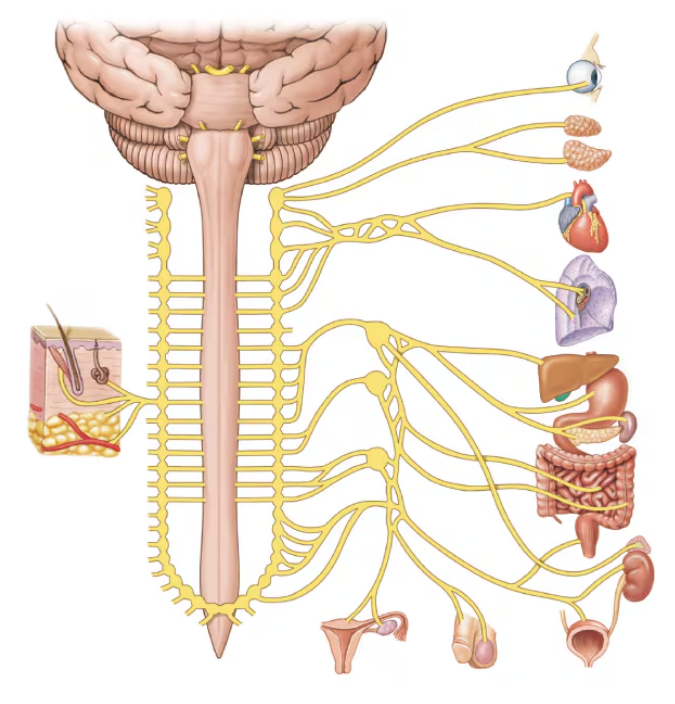
The preganglionic and ganglionic neurons are missing from the diagram below showing the distribution of sympathetic innervation. Indicate their distribution using red for the preganglionic neurons and black for the ganglionic neurons.
Diagram of sympathetic nerve pathways from spinal cord to organs, showing nerve branches to eye, heart, lungs, digestive and reproductive systems.

Verified step by step guidance
1
Step 1: Understand the roles of the neurons involved in sympathetic innervation. Preganglionic neurons originate in the spinal cord (specifically the thoracolumbar region) and send their axons to the sympathetic ganglia. Ganglionic neurons then relay the signal from the ganglia to the target organs.
Step 2: Identify the location of the preganglionic neurons. These neurons have their cell bodies in the lateral horn of the spinal cord segments T1 to L2. Their axons exit the spinal cord via the ventral roots and enter the sympathetic chain ganglia or collateral ganglia.
Step 3: Mark the preganglionic neurons in red on the diagram. Trace their path from the spinal cord to the sympathetic ganglia, showing their axons entering the ganglia.
Step 4: Identify the ganglionic neurons. These neurons have their cell bodies located within the sympathetic ganglia (either paravertebral or prevertebral). Their axons extend from the ganglia to the target tissues such as smooth muscle, cardiac muscle, or glands.
Step 5: Mark the ganglionic neurons in black on the diagram. Show their axons projecting from the ganglia to the effector organs, completing the sympathetic pathway.

Verified video answer for a similar problem:

This video solution was recommended by our tutors as helpful for the problem above.
Was this helpful?

Key Concepts

Here are the essential concepts you must grasp in order to answer the question correctly.

Sympathetic Nervous System Anatomy

The sympathetic nervous system consists of preganglionic neurons originating in the spinal cord and ganglionic neurons located in sympathetic ganglia. Understanding their anatomical locations and pathways is essential to map their distribution accurately in diagrams.
Recommended video:
1:21
Sympathetic Nervous System Example 3

Preganglionic and Ganglionic Neurons

Preganglionic neurons are the first-order neurons that arise from the spinal cord and synapse in ganglia, while ganglionic neurons are second-order neurons that extend from the ganglia to target organs. Differentiating these neurons by color coding helps visualize their roles and connections.
Recommended video:

Color Coding in Neuroanatomical Diagrams

Using distinct colors, such as red for preganglionic and black for ganglionic neurons, aids in distinguishing different neuron types and pathways in diagrams. This visual differentiation enhances comprehension of complex neural circuits and their functional organization.
Recommended video:
01:28
Genetic Code