Ch. 12 Nervous Tissue
Martini - Fundamentals of Anatomy & Physiology 11th Edition
Martini, Nath, Bartholomew11th EditionFundamentals of Anatomy & PhysiologyISBN: 9780136874089Not the one you use?Change textbook
Chapter 12, Problem 25

What factor determines the maximum frequency of action potentials that could be propagated by an axon?

Verified step by step guidance
1
Understand that the maximum frequency of action potentials an axon can propagate is primarily limited by the refractory periods of the neuron.
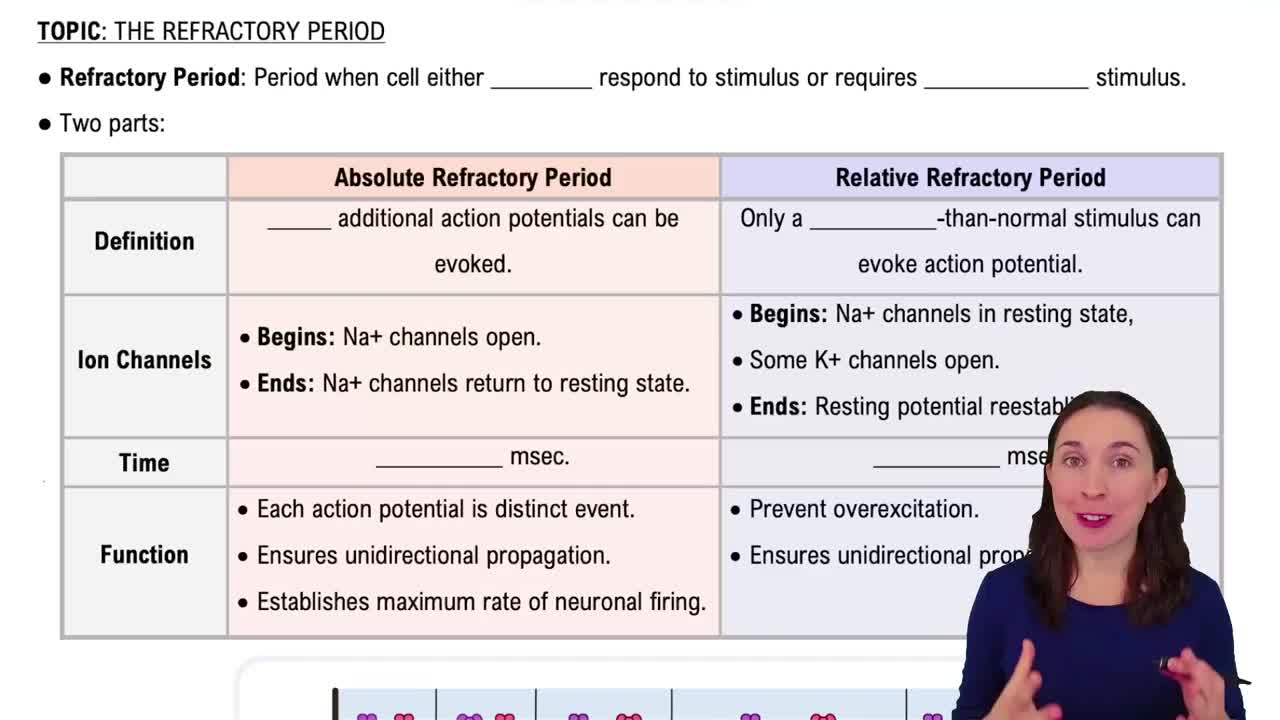
Recall that there are two refractory periods: the absolute refractory period, during which no new action potential can be initiated, and the relative refractory period, during which a stronger-than-normal stimulus is required.
Recognize that the absolute refractory period sets the minimum time interval between two consecutive action potentials, thus determining the maximum firing frequency.
Express the maximum frequency mathematically as the reciprocal of the absolute refractory period: \(\text{Maximum Frequency} = \frac{1}{\text{Absolute Refractory Period}}\).
Consider that factors affecting the duration of the refractory period, such as ion channel kinetics and axon properties, will influence the maximum frequency of action potentials.

Verified video answer for a similar problem:

This video solution was recommended by our tutors as helpful for the problem above.
Video duration:
5m
Was this helpful?

Key Concepts

Here are the essential concepts you must grasp in order to answer the question correctly.

Refractory Period

The refractory period is the time after an action potential during which a neuron is unable or less able to fire another action potential. It includes the absolute refractory period, where no new action potential can be initiated, and the relative refractory period, where initiation is possible but requires a stronger stimulus. This period limits the maximum frequency of action potentials.
Recommended video:
06:26
Refractory Period

Ion Channel Dynamics

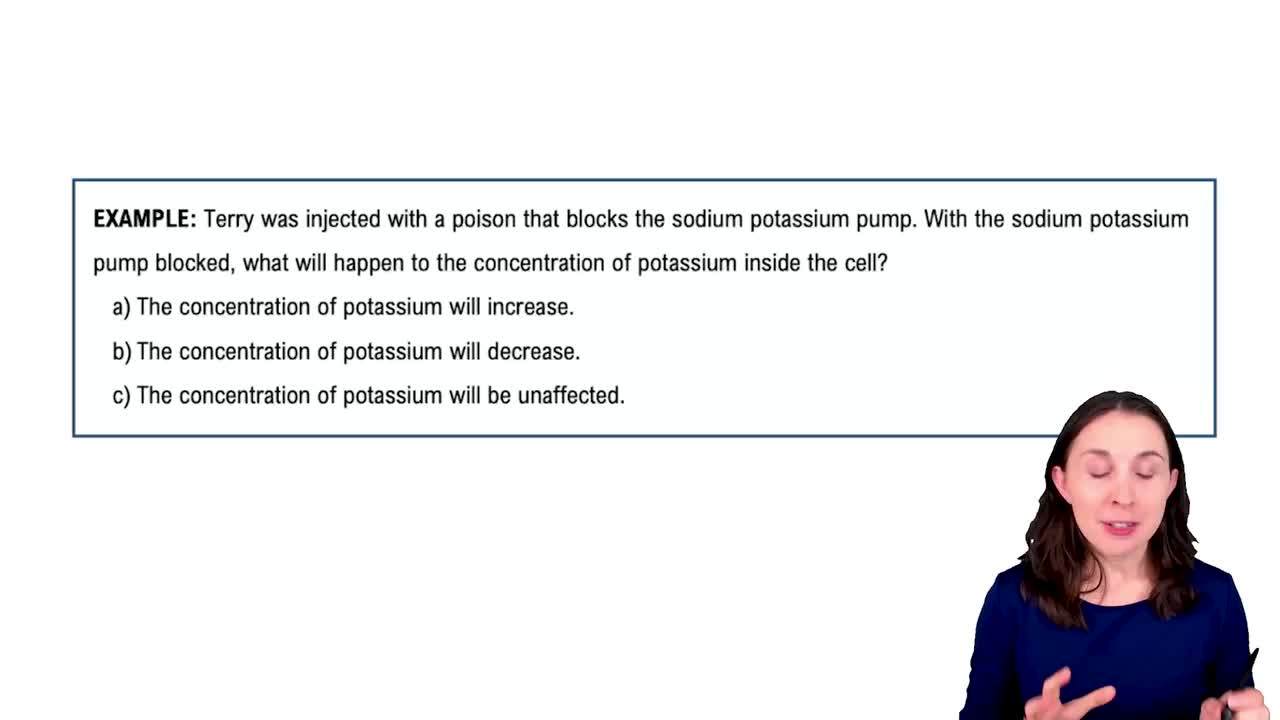
Ion channels, especially voltage-gated sodium and potassium channels, control the initiation and propagation of action potentials. Their opening and closing kinetics determine how quickly a neuron can reset after an action potential, influencing the refractory period and thus the maximum firing frequency.
Recommended video:
01:55
Ions - Sodium and Potassium Example 3

Axonal Membrane Properties

The physical and electrical properties of the axonal membrane, such as capacitance and resistance, affect how quickly the membrane potential can change. These properties influence the speed of repolarization and recovery, thereby impacting the maximum rate at which action potentials can be propagated.
Recommended video:
04:07
Properties of Water- Thermal