Ch. 19 Blood
Martini - Fundamentals of Anatomy & Physiology 11th Edition
Martini, Nath, Bartholomew11th EditionFundamentals of Anatomy & PhysiologyISBN: 9780136874089Not the one you use?Change textbook
Chapter 19, Problem 16

What is the difference between prothrombin and thrombin?

Verified step by step guidance
1
Step 1: Understand that both prothrombin and thrombin are proteins involved in the blood clotting process, also known as coagulation.
Step 2: Recognize that prothrombin is an inactive precursor protein (a zymogen) produced by the liver and circulates in the blood plasma.
Step 3: Learn that thrombin is the active enzyme form that is generated when prothrombin is cleaved by activated factor X (also called prothrombinase complex) during the coagulation cascade.
Step 4: Know that thrombin's main function is to convert soluble fibrinogen into insoluble fibrin strands, which form the meshwork of a blood clot.
Step 5: Summarize the difference: prothrombin is the inactive precursor, while thrombin is the active enzyme that directly participates in clot formation.

Verified video answer for a similar problem:

This video solution was recommended by our tutors as helpful for the problem above.
Was this helpful?

Key Concepts

Here are the essential concepts you must grasp in order to answer the question correctly.

Prothrombin

Prothrombin is an inactive plasma protein produced by the liver that serves as a precursor to thrombin. It circulates in the blood and is converted into thrombin during the coagulation process, playing a crucial role in blood clot formation.
Recommended video:
3:40
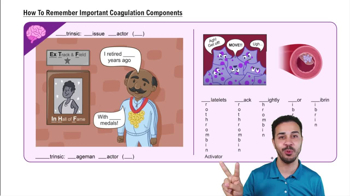
How To Remember Important Coagulation Components

Thrombin

Thrombin is an active enzyme formed from prothrombin during blood coagulation. It catalyzes the conversion of fibrinogen into fibrin, which forms the structural basis of a blood clot, thus playing a central role in stopping bleeding.
Recommended video:
3:40
How To Remember Important Coagulation Components

Coagulation Cascade

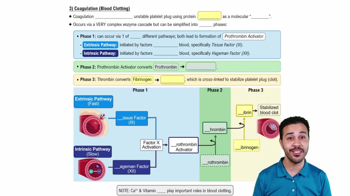
The coagulation cascade is a series of enzymatic reactions that lead to blood clotting. It involves the activation of prothrombin to thrombin, which then converts fibrinogen to fibrin, stabilizing the clot and preventing excessive bleeding.
Recommended video:
10:05
Coagulation (Blood Clotting)