Ch. 15 The Urinary System
Marieb - Essentials of Human Anatomy & Physiology 13th Edition
Marieb13th EditionEssentials of Human Anatomy & PhysiologyISBN: 9780135624340Not the one you use?Change textbook
Chapter 15, Problem 27

Two physiology students are having a disagreement about renal function. Dan says that the kidneys work harder when you eat a high-salt diet, whereas Peter says that they work harder when you drink lots of water. Who is right, and why?

Verified step by step guidance
1
Step 1: Begin by understanding the primary functions of the kidneys. The kidneys are responsible for filtering blood, maintaining electrolyte balance, regulating fluid levels, and excreting waste products through urine. They adjust their workload based on the body's needs.
Step 2: Analyze Dan's claim about a high-salt diet. A high-salt diet increases the concentration of sodium in the blood. The kidneys respond by filtering out excess sodium to maintain homeostasis. This process involves increased reabsorption and excretion mechanisms, which can place additional workload on the kidneys.
Step 3: Examine Peter's claim about drinking lots of water. When you consume large amounts of water, the kidneys work to maintain fluid balance by excreting the excess water as dilute urine. This process involves adjusting the concentration of urine through mechanisms like reduced reabsorption of water in the nephron.
Step 4: Compare the two scenarios. Both high-salt intake and excessive water consumption require the kidneys to adjust their filtration and excretion processes. However, the type of workload differs: high-salt intake primarily affects electrolyte regulation, while excessive water intake primarily affects fluid balance.
Step 5: Conclude that both Dan and Peter are correct in their own contexts. The kidneys work harder in both scenarios, but the specific mechanisms and physiological processes involved differ based on whether the challenge is related to salt or water intake.

Verified video answer for a similar problem:

This video solution was recommended by our tutors as helpful for the problem above.
Video duration:
1m
Was this helpful?

Key Concepts

Here are the essential concepts you must grasp in order to answer the question correctly.

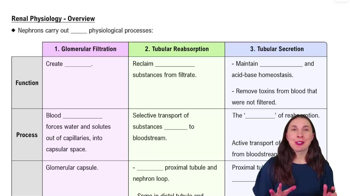
Renal Physiology

Renal physiology is the study of kidney function and the processes involved in filtering blood, regulating electrolytes, and maintaining fluid balance. The kidneys play a crucial role in homeostasis by adjusting the volume and composition of body fluids, which is influenced by dietary intake, such as salt and water.
Recommended video:
4:58
Overview of Renal Physiology

Osmoregulation

Osmoregulation refers to the process by which the body maintains the balance of water and electrolytes in the blood. When consuming a high-salt diet, the kidneys must excrete excess sodium while retaining water to prevent dehydration, whereas drinking lots of water requires the kidneys to excrete the surplus to maintain osmotic balance.
Recommended video:
07:16
Osmoregulation and Nitrogenous Waste

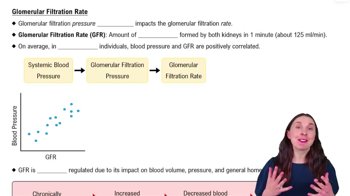
Glomerular Filtration Rate (GFR)

Glomerular filtration rate (GFR) is a measure of how well the kidneys filter blood, indicating renal function. GFR can be affected by fluid intake; high water consumption can increase GFR, leading to more urine production, while a high-salt diet can lead to increased workload on the kidneys to excrete excess sodium and maintain fluid balance.
Recommended video:
3:15
Glomerular Filtration Rate