Ch. 4 Skin and Body Membranes
Marieb - Essentials of Human Anatomy & Physiology 13th Edition
Marieb13th EditionEssentials of Human Anatomy & PhysiologyISBN: 9780135624340Not the one you use?Change textbook
Chapter 4, Problem 9d

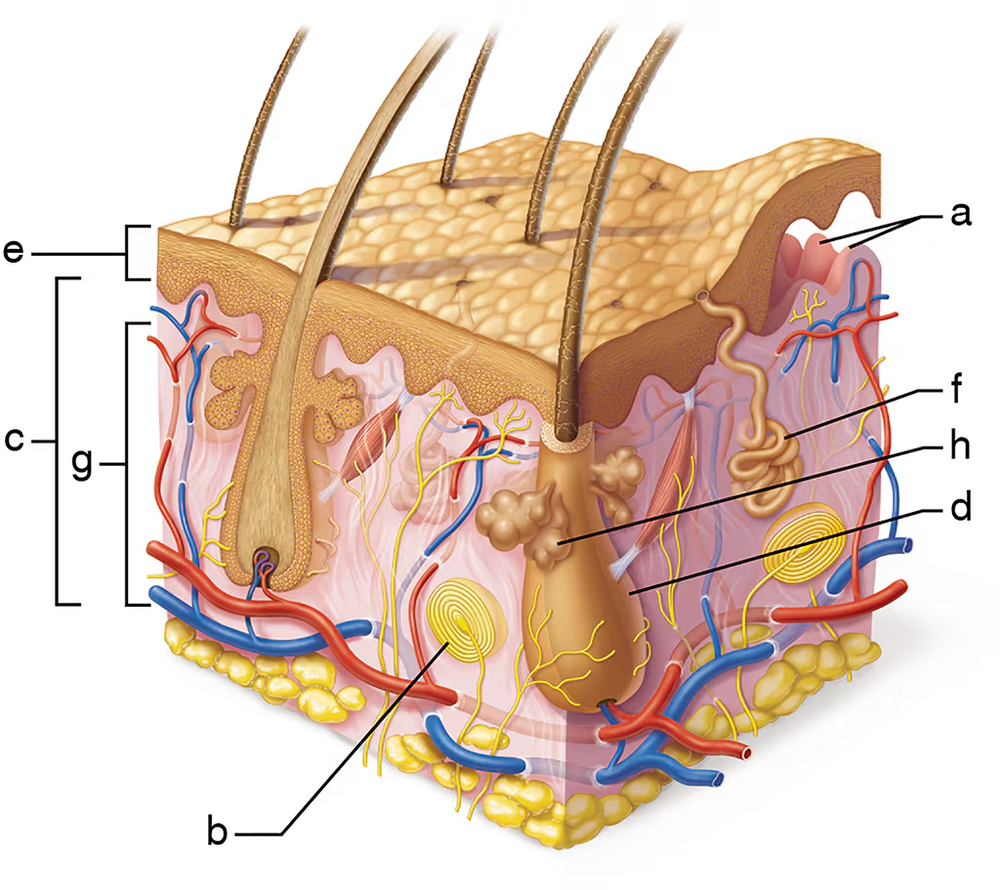
Match the appropriate structure with the proper description and/or function.
Illustration of skin layers and structures, including hair follicles, sweat glands, and blood vessels, labeled for identification.
4. Cause Fingerprints
a. Dermal papillae
b. Lamellar corpuscles
c. Dermis
d. Hair follicle
e. Epidermis
f. Eccrine sweat gland
g. Reticular layer
h. Sebaceous glands

Verified step by step guidance
1
Understand the anatomy of the skin and its layers: The skin consists of three main layers—epidermis, dermis, and hypodermis. The dermis is further divided into the papillary layer and the reticular layer. Fingerprints are formed by structures in the dermis, specifically the dermal papillae.
Learn the role of dermal papillae: Dermal papillae are small, finger-like projections in the papillary layer of the dermis. They interlock with the epidermis and create ridges on the skin's surface, which are responsible for fingerprints.
Differentiate dermal papillae from other structures: Lamellar corpuscles are sensory receptors for pressure, eccrine sweat glands produce sweat, sebaceous glands secrete oil, and the reticular layer provides strength and elasticity to the skin. None of these directly cause fingerprints.
Understand the relationship between dermal papillae and fingerprints: The ridges formed by dermal papillae are genetically determined and unique to each individual. These ridges are what create the patterns observed in fingerprints.
Match the correct structure: Based on the description and function, the structure responsible for causing fingerprints is 'a. dermal papillae'.

Verified video answer for a similar problem:

This video solution was recommended by our tutors as helpful for the problem above.
Video duration:
2m
Was this helpful?

Key Concepts

Here are the essential concepts you must grasp in order to answer the question correctly.

Dermal Papillae

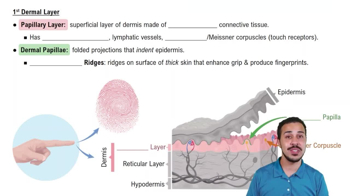
Dermal papillae are small, nipple-like projections located at the junction of the dermis and epidermis. They play a crucial role in the formation of fingerprints by creating unique patterns on the skin's surface. These structures contain capillaries and nerve endings, contributing to the skin's sensitivity and nourishment.
Recommended video:
06:14
1st Dermal Layer

Epidermis

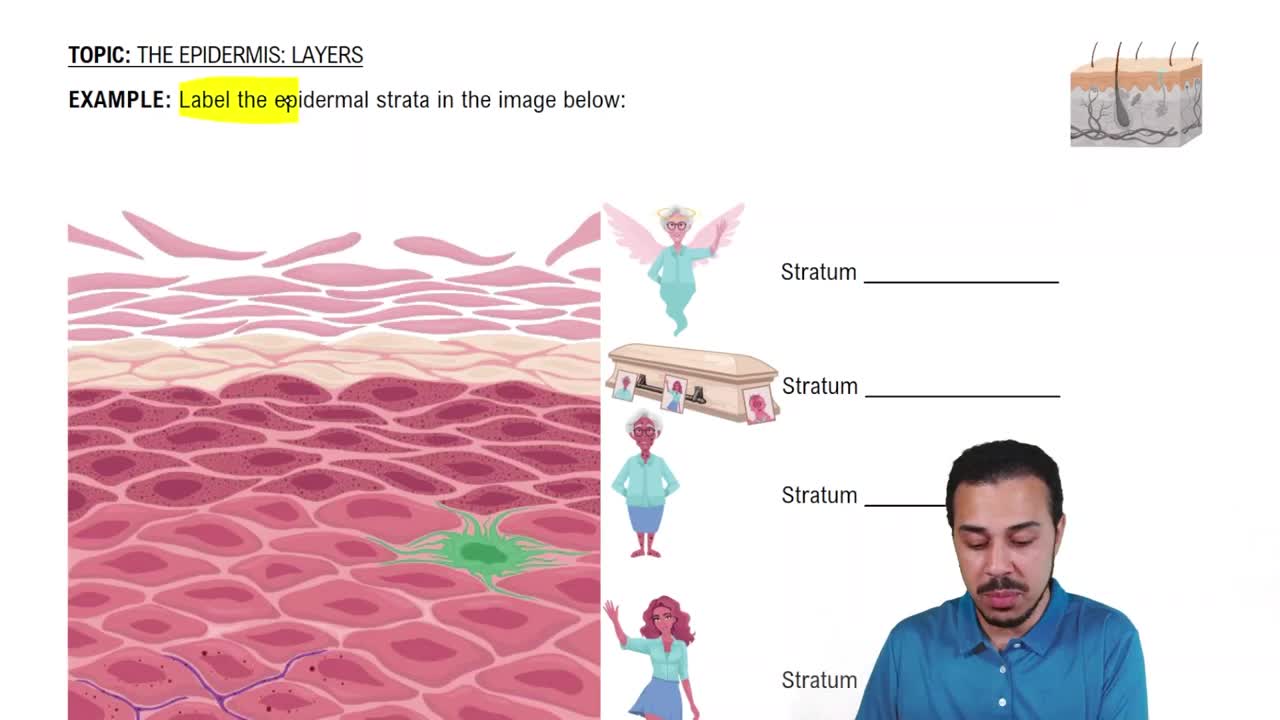
The epidermis is the outermost layer of skin, providing a protective barrier against environmental factors. It is composed of keratinized cells and does not contain blood vessels. The epidermis is essential for the formation of skin features, including fingerprints, as it is where the patterns created by dermal papillae are expressed.
Recommended video:
04:09
The Epidermis: Layers Example 2

Dermis

The dermis is the layer of skin beneath the epidermis, consisting of connective tissue, blood vessels, and various structures such as hair follicles and glands. It supports the epidermis and houses the dermal papillae, which are responsible for the unique patterns of fingerprints. The dermis also plays a vital role in thermoregulation and sensation.
Recommended video:
01:20
Introduction to the Dermis
Related Practice
Textbook Question

Match the appropriate structure with the proper description and/or function.

1. Made of dense, irregular connective tissue

 2. Produce sebum

3. Helps regulate body temperature by producing sweat

4. Cause fingerprints

5. Houses the hair root

6. Superficial keratinized stratified squamous epithelium

7. Deep pressure receptors

8. Vascular layer that houses skin appendages

a. Dermal papillae

b. Lamellar corpuscles

c. Dermis

d. Hair follicle

e. Epidermis

f. Eccrine sweat gland

g. Reticular layer

h. Sebaceous glands

39
views
Textbook Question

Match the appropriate structure with the proper description and/or function.

1. Made of dense, irregular connective tissue

 2. Produce sebum

3. Helps regulate body temperature by producing sweat

4. Cause fingerprints

5. Houses the hair root

6. Superficial keratinized stratified squamous epithelium

7. Deep pressure receptors

8. Vascular layer that houses skin appendages

a. Dermal papillae

b. Lamellar corpuscles

c. Dermis

d. Hair follicle

e. Epidermis

f. Eccrine sweat gland

g. Reticular layer

h. Sebaceous glands

35
views
Textbook Question

Match the appropriate structure with the proper description and/or function.

1. Made of dense, irregular connective tissue

 2. Produce sebum

3. Helps regulate body temperature by producing sweat

4. Cause fingerprints

5. Houses the hair root

6. Superficial keratinized stratified squamous epithelium

7. Deep pressure receptors

8. Vascular layer that houses skin appendages

a. Dermal papillae

b. Lamellar corpuscles

c. Dermis

d. Hair follicle

e. Epidermis

f. Eccrine sweat gland

g. Reticular layer

h. Sebaceous glands

49
views
Textbook Question

Which of the following is not a skin structure?

a. Nerve fiber

b. Hair papilla

c. Hair

d. Nail

128
views