Ch. 7 The Nervous System
Marieb - Essentials of Human Anatomy & Physiology 13th Edition
Marieb13th EditionEssentials of Human Anatomy & PhysiologyISBN: 9780135624340Not the one you use?Change textbook
Chapter 7, Problem 6g

Choose the proper term to respond to the statements describing various brain areas.
a. Cerebellum
b. Corpora quadrigemina
c. Corpus callosum
d. Hypothalamus
e. Medulla
f. Midbrain
g. Pons
h. Thalamus
7. Brain area most concerned with equilibrium, body posture, and coordination of motor activity.

Verified step by step guidance
1
Step 1: Begin by analyzing the question. It asks for the brain area most concerned with equilibrium, body posture, and coordination of motor activity. These functions are related to motor control and balance.
Step 2: Review the provided options and their associated functions: - Cerebellum: Responsible for coordination, balance, and fine-tuning motor activity. - Corpora quadrigemina: Involved in visual and auditory reflexes. - Corpus callosum: Connects the two hemispheres of the brain for communication. - Hypothalamus: Regulates autonomic functions, emotions, and endocrine activity. - Medulla: Controls vital functions like breathing and heart rate. - Midbrain: Plays a role in motor movement and auditory/visual processing. - Pons: Assists in motor control and sensory analysis. - Thalamus: Acts as a relay station for sensory information.
Step 3: Focus on the key terms in the question: equilibrium, body posture, and coordination of motor activity. These are hallmark functions of the cerebellum, which fine-tunes motor movements and maintains balance.
Step 4: Eliminate options that do not align with the described functions. For example, the corpus callosum is involved in communication between hemispheres, not motor coordination. Similarly, the hypothalamus and thalamus are more related to sensory and autonomic functions.
Step 5: Conclude that the cerebellum is the most appropriate choice based on its role in equilibrium, posture, and motor coordination. This aligns with the question's requirements.

Verified video answer for a similar problem:

This video solution was recommended by our tutors as helpful for the problem above.
Video duration:
2m
Was this helpful?

Key Concepts

Here are the essential concepts you must grasp in order to answer the question correctly.

Cerebellum

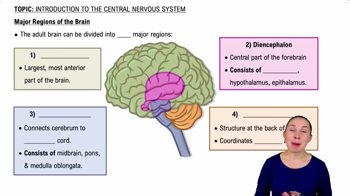
The cerebellum is a brain structure located at the back of the skull, responsible for coordinating voluntary movements, maintaining posture, and ensuring balance. It integrates sensory information from the spinal cord and other parts of the brain to fine-tune motor activity, making it essential for activities that require precision and timing.
Recommended video:
3:10
Major Regions of the Brain

Equilibrium

Equilibrium refers to the state of balance and stability in the body, which is crucial for maintaining posture and coordinating movements. The cerebellum plays a vital role in processing sensory inputs related to balance, such as those from the inner ear, and adjusting motor outputs to keep the body stable during movement.
Recommended video:
02:44
Diffusion

Motor Coordination

Motor coordination involves the ability to execute smooth, controlled movements by integrating sensory feedback and motor commands. The cerebellum is key in this process, as it helps to synchronize muscle activity and adjust movements based on real-time feedback, which is essential for activities ranging from walking to playing sports.
Recommended video:
4:31
Primary Motor Cortex & Primary Somatosensory Cortex