Ch. 15 The Urinary System
Marieb - Essentials of Human Anatomy & Physiology 13th Edition
Marieb13th EditionEssentials of Human Anatomy & PhysiologyISBN: 9780135624340Not the one you use?Change textbook
Chapter 15, Problem 12

Trace the pathway a uric acid molecule takes from a glomerulus to the urethra. Name every gross or microscopic structure it passes through on its journey.

Verified step by step guidance
1
Start at the glomerulus, where the uric acid molecule is filtered from the blood into the Bowman's capsule, entering the nephron as part of the filtrate.
Move through the proximal convoluted tubule, where some reabsorption of water, ions, and nutrients occurs, but the uric acid molecule remains in the filtrate.
Travel down the loop of Henle, first descending into the medulla (where water is reabsorbed) and then ascending back toward the cortex (where ions like sodium and chloride are reabsorbed). The uric acid molecule continues in the filtrate.
Pass through the distal convoluted tubule, where further adjustments to the filtrate composition occur, and then enter the collecting duct, which carries the now-concentrated urine through the renal medulla toward the renal pelvis.
Exit the kidney via the renal pelvis into the ureter, travel down the ureter to the urinary bladder for storage, and finally leave the body through the urethra during urination.

Verified video answer for a similar problem:

This video solution was recommended by our tutors as helpful for the problem above.
Video duration:
1m
Was this helpful?

Key Concepts

Here are the essential concepts you must grasp in order to answer the question correctly.

Nephron Structure

The nephron is the functional unit of the kidney, consisting of a glomerulus and a renal tubule. Uric acid is filtered from the blood in the glomerulus, where it enters the renal tubule. The nephron's structure is crucial for understanding how substances are processed and excreted in the urinary system.
Recommended video:
0:50
The Nephron Example 1

Renal Tubule Segments

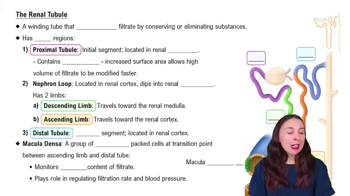
The renal tubule is divided into several segments: the proximal convoluted tubule, loop of Henle, distal convoluted tubule, and collecting duct. Each segment plays a specific role in reabsorption and secretion of substances, including uric acid. Understanding these segments is essential for tracing the pathway of uric acid from the nephron to the urethra.
Recommended video:
4:21
The Renal Tubule

Urinary Tract

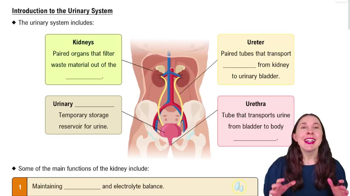
The urinary tract includes the ureters, bladder, and urethra, which are responsible for transporting and storing urine. After passing through the nephron, uric acid enters the collecting ducts, moves through the ureters, is stored in the bladder, and finally exits the body through the urethra. Familiarity with the urinary tract's anatomy is vital for comprehending the complete pathway of uric acid.
Recommended video:
2:57
The Urinary System