Ch. 20 The Heart
Martini - Fundamentals of Anatomy & Physiology 11th Edition
Martini, Nath, Bartholomew11th EditionFundamentals of Anatomy & PhysiologyISBN: 9780136874089Not the one you use?Change textbook
Chapter 20, Problem 26

What effect does sympathetic stimulation have on the heart? What effect does parasympathetic stimulation have on the heart?

Verified step by step guidance
1
Step 1: Understand the autonomic nervous system's role in regulating heart function. The sympathetic and parasympathetic divisions have opposite effects on the heart to maintain homeostasis.
Step 2: Recognize that sympathetic stimulation increases heart rate and force of contraction. This occurs because sympathetic nerves release norepinephrine, which binds to beta-1 adrenergic receptors on cardiac muscle cells.
Step 3: Note that sympathetic stimulation also increases the speed of electrical conduction through the heart, particularly at the sinoatrial (SA) node and atrioventricular (AV) node, leading to a faster heartbeat.
Step 4: Understand that parasympathetic stimulation decreases heart rate by releasing acetylcholine, which acts on muscarinic receptors in the SA and AV nodes, slowing the rate of depolarization and conduction.
Step 5: Summarize that parasympathetic stimulation primarily reduces heart rate without significantly affecting the force of contraction, promoting a state of rest and energy conservation.

Verified video answer for a similar problem:

This video solution was recommended by our tutors as helpful for the problem above.
Was this helpful?

Key Concepts

Here are the essential concepts you must grasp in order to answer the question correctly.

Sympathetic Nervous System and Cardiac Function

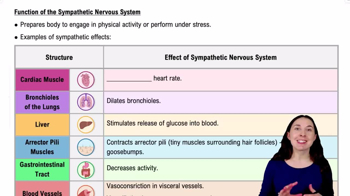
The sympathetic nervous system increases heart rate and force of contraction by releasing norepinephrine, which binds to beta-1 adrenergic receptors on cardiac cells. This prepares the body for 'fight or flight' responses by enhancing cardiac output and blood flow to muscles.
Recommended video:
2:52
Function of the Sympathetic Nervous System

Parasympathetic Nervous System and Cardiac Function

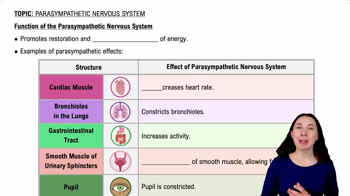
The parasympathetic nervous system decreases heart rate by releasing acetylcholine, which acts on muscarinic receptors in the heart, primarily the sinoatrial node. This promotes 'rest and digest' activities by slowing the heart rate and conserving energy.
Recommended video:
1:56
Function of the Parasympathetic Nervous System

Autonomic Regulation of Heart Rate

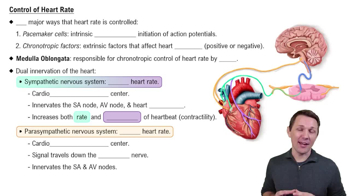
Heart rate is regulated by the balance between sympathetic and parasympathetic inputs to the sinoatrial node. Sympathetic stimulation accelerates heart rate, while parasympathetic stimulation slows it, allowing the body to adapt to varying physiological demands.
Recommended video:
Guided course
6:13
Control of Heart Rate