Ch. 14 The Digestive System and Body Metabolism
Marieb - Essentials of Human Anatomy & Physiology 13th Edition
Marieb13th EditionEssentials of Human Anatomy & PhysiologyISBN: 9780135624340Not the one you use?Change textbook
Chapter 14, Problem 3

More than one choice may apply.
The GI tube tissue layer responsible for the actions of segmentation and peristalsis is the
a. Serosa
b. Mucosa
c. Muscularis externa
d. Submucosa

Verified step by step guidance
1
Understand the question: The problem is asking which tissue layer of the gastrointestinal (GI) tube is responsible for segmentation and peristalsis, which are movements that help mix and propel food through the digestive tract.
Define segmentation and peristalsis: Segmentation involves localized contractions that mix food with digestive enzymes, while peristalsis refers to wave-like contractions that propel food forward through the GI tract.
Review the structure of the GI tube: The GI tube has four main layers: mucosa (innermost layer), submucosa, muscularis externa, and serosa (outermost layer). Each layer has specific functions.
Focus on the muscularis externa: This layer contains smooth muscle arranged in two layers—an inner circular layer and an outer longitudinal layer. These muscle layers are responsible for the coordinated contractions that produce segmentation and peristalsis.
Eliminate incorrect options: The serosa is the outermost protective layer, the mucosa is involved in secretion and absorption, and the submucosa provides structural support and contains blood vessels and nerves. None of these are directly responsible for segmentation and peristalsis.

Verified video answer for a similar problem:

This video solution was recommended by our tutors as helpful for the problem above.
Video duration:
2m
Was this helpful?

Key Concepts

Here are the essential concepts you must grasp in order to answer the question correctly.

GI Tract Layers

The gastrointestinal (GI) tract is composed of four main layers: the mucosa, submucosa, muscularis externa, and serosa. Each layer has distinct functions, with the muscularis externa playing a crucial role in the movement of food through the digestive system.
Recommended video:
02:31
Epidermal Layers: Stratum Lucidum (Clear Layer)

Muscularis Externa

The muscularis externa is the layer of the GI tract responsible for the contractions that facilitate segmentation and peristalsis. It consists of two layers of muscle: an inner circular layer and an outer longitudinal layer, which work together to propel food along the digestive tract.
Recommended video:
Guided course
6:17
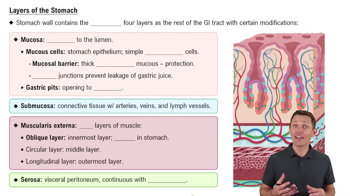
Layers of the Stomach

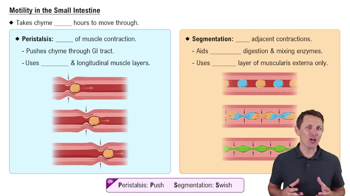
Segmentation and Peristalsis

Segmentation and peristalsis are two types of muscular contractions in the GI tract. Segmentation involves rhythmic contractions that mix food with digestive juices, while peristalsis is a wave-like motion that moves food through the digestive system, ensuring efficient digestion and absorption.
Recommended video:
Guided course
3:06
Motility in the Small Intestine